Moussem of Tan-Tan Festival
Some events you don't really plan for. You hear about them by chance, you look a little deeper, and before you know it you're reorganising your entire itinerary. The Tan-Tan Moussem is that kind of event. Recognised by UNESCO as an Intangible Cultural Heritage of Humanity since 2005, this nomadic gathering is one of the largest and most extraordinary of its kind anywhere in the Arab world, and yet very few Western travellers have ever heard of it. That, more than anything else, is what makes it so rare and so worth the effort.
What Is the Tan-Tan Moussem?
A moussem, in Arabic, refers to a traditional periodic festival. Across Morocco, these gatherings have shaped community life for centuries, weaving together religious ceremony, social reunion and commercial exchange in a way that no other format quite replicates. Tan-Tan's version is in a category of its own. What sets it apart is the sheer diversity of people it draws: nomadic tribes from Morocco's deep south, communities from Western Sahara, and visitors travelling from as far afield as Mauritania and Senegal.
In its original form, the moussem served as an annual meeting point for the Sahrawi and Berber peoples of the region. People came to trade, to celebrate, and to reconnect after months of desert transhumance. That soul is still entirely intact today, even as the event has gradually opened itself to outside visitors. UNESCO's 2005 recognition was not a formality; it was an acknowledgement of something genuinely irreplaceable.
The range of communities represented is remarkable. Sahrawi tribes, Tuareg groups, southern Berber communities, Mauritanian families: all of them converge on Tan-Tan in what feels, once you're there, like a great collective exhale from the desert.
Where and When
Tan-Tan sits deep in Morocco's far south, around 125 km below Guelmim and roughly 1,100 km from Casablanca. It's a long way. That distance is part of the experience, the sense that you've genuinely committed to something, that you've followed a thread all the way to its end.
The Moussem typically takes place in spring, somewhere between April and May, running for approximately a week. Dates shift from year to year, so checking the official calendar well in advance is essential before booking anything.
Getting there takes some planning. By car from Agadir, allow around four hours on the road. CTM buses connect Tan-Tan to the major cities, though the journey is long and services are limited. There is also an airport handling a small number of domestic flights from Casablanca. For families or anyone who values flexibility, hiring a car is easily the most practical solution.
What You'll See and Feel
The moment you step onto the site, the spectacle hits you all at once. Camel caravans move through the grounds, traditional wool tents stretch out in every direction, and the vivid colours of Sahrawi dress cut sharply against the surrounding desert landscape. It's a visual shock, and entirely the right kind.
Music runs through everything. Gnawa rhythms carry on well into the night, layered with Hassani songs, the distinctive melodies of the Western Saharan peoples. Circles form spontaneously around musicians, children dance, elders watch. The atmosphere is warm and festive in a way that feels entirely unperformed.
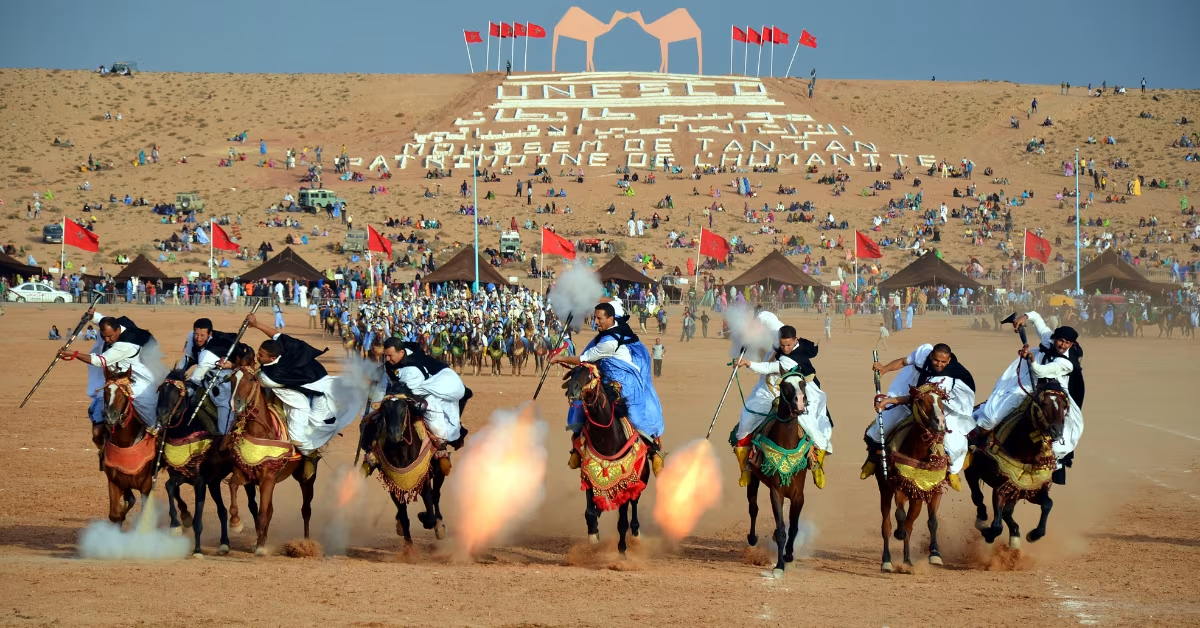
The fantasias are among the event's most memorable moments, those traditional equestrian displays where riders drive their horses at full gallop before firing their rifles in unison, producing a thunder that rolls through the crowd and leaves everyone momentarily breathless. Loud, dramatic, and genuinely moving.
The commercial side of the moussem is just as lively. Merchants offer Berber jewellery, textiles, spices, saddlery and Sahrawi craft work in what amounts to an open-air souk of considerable size. If you want to bring something home that carries a real story with it, this is the place, a very long way from the standardised tourist trinkets found in the more heavily visited medinas up north.
Practical Matters
Accommodation books up fast : Tan-Tan is a small town, and during the Moussem its limited hotel stock disappears quickly, so reserving well ahead is non-negotiable. Camping near the site is available and genuinely recommended for those who want to be fully immersed in the atmosphere rather than retreating each evening to town.
For clothing, light layers work best during the day, but bring something warm for after sunset because spring nights in the south can be genuinely cold. Modest, covered dress is expected both in the village and on the festival grounds, out of straightforward respect for the families and communities around you.
Budget-wise, entry to the site is typically free or very low cost. Expect to spend somewhere between 300 and 500 dirhams per person per day across food, purchases and incidentals. Transport and accommodation are where the real costs sit.
A few things worth keeping in mind: always ask before photographing people, especially women. Give prayer spaces a wide berth. And hold onto the awareness that you are a guest at a celebration that belongs, first and foremost, to the communities living it.
What's Nearby
The surrounding region rewards travellers who take the time to explore beyond the event itself.
Tan-Tan Plage, 20 km from Tan-Tan town, is a wild and barely visited stretch of coast where ochre cliffs drop straight into the Atlantic. The contrast between desert and ocean is striking. Swimming is possible, though the currents deserve respect.
Guelmim, 125 km north, is known as the Gateway to the Sahara and is home to one of Morocco's most important camel markets. For anyone drawn to authenticity and open space, it's an essential stop.
Sidi Ifni, around 180 km north, is a former Spanish enclave balanced on Atlantic cliffs, with genuinely surprising colonial architecture and a distinct end-of-the-world quality. Surfers found it years ago; other travellers are only just catching on.
Laâyoune, 350 km to the south, is the main city of Western Sahara: modern, busy, with lively souks and desert landscapes beginning right at the city's edge. The drive down is worth something in itself.
The Chegaga Dunes, roughly 200 km east and reachable via Guelmim, are vast, largely untouched, and ideal for a night of wild camping under an unobstructed sky. The kind of experience that stays with you for years.
Plage Blanche, about 100 km north of Tan-Tan, is one of Morocco's longest and most deserted beaches, accessible by 4x4 only. For those genuinely trying to step outside of time for a day, it fits the brief perfectly.
Why This Is Worth Your Time
Some trips enrich you. Others change you. The Tan-Tan Moussem sits firmly in the second camp. This is not a show designed around tourists, and it is not a folkloric reconstruction staged for the cameras. It is a living, sincere celebration carried forward by communities who have been doing this for generations, and who are willing to share it with the wider world.
If you're looking for a Morocco far removed from the well-worn routes and the curated riad experience, Tan-Tan is a serious answer to that question. Note the dates, book early, and point yourself south. You won't regret the detour.
Register
By entering your email address, you agree to receive our newsletters by email and you are aware of our Privacy Policy.