Stunning Cliffs of Tan-Tan
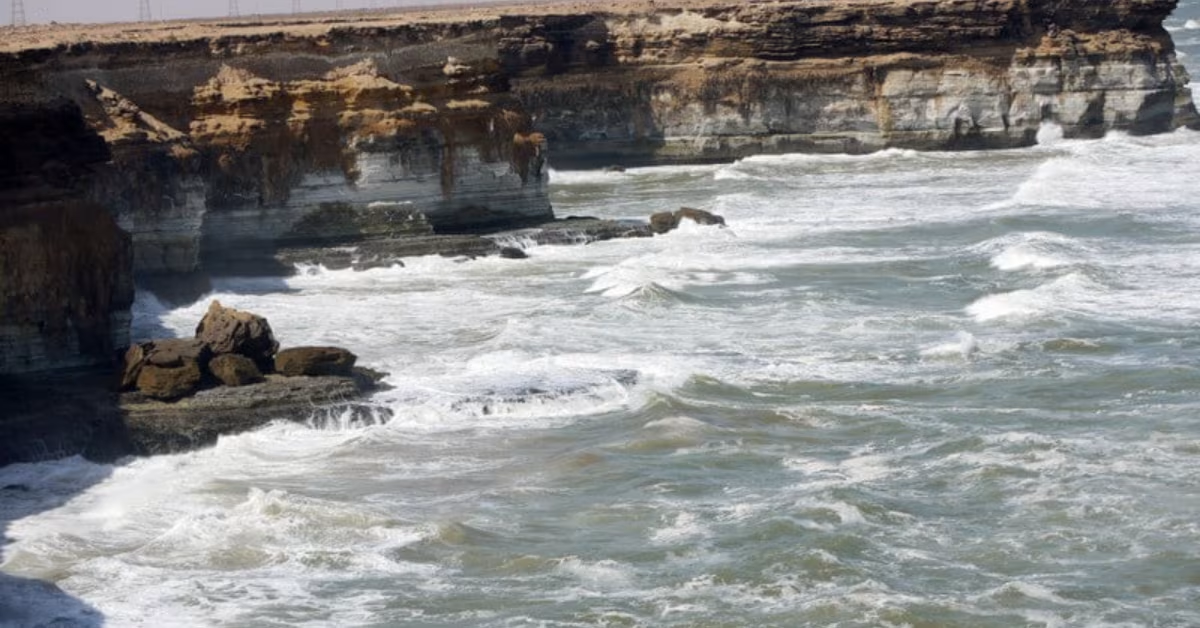
Morocco has no shortage of postcard-perfect destinations plastered across every travel poster. But then there are places like this. The coastal stretch running between Tan-Tan and Tarfaya is one of the most wild and striking landscapes in the entire country, and yet it almost never appears on standard itineraries. Ochre cliffs dropping straight into the Atlantic, a desert that ends with its feet in the water, a light that shifts hour by hour and turns every bend in the road into a painting. If you are looking for something authentic, raw, and genuinely different, you are in the right place.
Where is this coastline?
Between two towns, a world apart
Tan-Tan and Tarfaya are two towns in southern Morocco, located in the Guelmim-Oued Noun region and in Western Sahara. Tan-Tan lies around 320 kilometres south of Agadir, and Tarfaya roughly a hundred kilometres further south still, sitting across the water from the Canary Islands. Between the two, a coastal road follows the Atlantic for dozens of kilometres, cutting through a territory that is arid, sparsely populated, and absolutely disarming in its beauty.
Where the desert meets the ocean
It is precisely this meeting point that makes this stretch so remarkable. On one side, the Sahara, with its stony expanses, its tawny golden colours, and its heavy silence. On the other, the Atlantic, powerful, restless, at times furious. The cliffs form the boundary between these two worlds, and standing at the edge, you get the distinct feeling that the earth genuinely stops here, as though nothing beyond it exists.
The Cliffs: What You Actually See
Forms carved by time
The cliffs along this coastline are the result of millions of years of erosion. In places they rise several dozen metres above the sea, with sheer vertical faces, natural arches hollowed out by the waves, and rocky plateaus jutting out over the void. The colours shift between pale beige, warm rust, and dark grey depending on the composition of the rock, and when the late afternoon sun catches them side-on, the spectacle is genuinely hard to put into words.
Light as a defining element
The light here is something else entirely. It is intense, direct, unfiltered, shaped by the proximity of both desert and ocean. In the morning, a faint Atlantic mist softens the edges. At midday, everything is sharp, almost harsh. At sunset, the cliffs seem to catch fire, and photographers who make the trip for those hours alone never leave disappointed.
A discreet but real wildlife presence
This coastline is an important migratory corridor for a wide variety of bird species. Falcons, herons, gulls, and terns share the cliffs and the nearby wetlands. The Mediterranean monk seal, an extremely rare and protected species, frequents certain sea caves along the coast. You are unlikely to encounter one, but knowing they are out there adds something to the magic of the place.
What to Do on the Ground
Exploring the cliffs on foot
The areas around the cliffs are easy to walk, along informal paths that follow the edge. It is an accessible outing with no serious technical difficulty, though it requires care and attention, particularly with children, as the edges are unguarded and the ground can be unstable. The reward is a continuous succession of viewpoints, each one shifting every hundred metres, each more impressive than the last.
Photography
It is nearly impossible not to reach for a camera every five minutes. The cliffs, the sea below, the shifting sky, and occasionally a solitary fisherman perched on a rock: this coastline is a permanent natural composition. Sunrise and sunset are the most sought-after moments, but even in the middle of the day the light produces striking contrasts.
Encounters with local fishermen
All along this coast, you regularly come across small groups of fishermen, often Sahrawi, casting lines or nets from the rocks. These encounters are among the most memorable of the journey: simple, spontaneous, with no intermediary. A few words are enough, and sometimes none are needed at all, to share a moment worth a thousand guided tours.
Sleeping under the stars
For travellers comfortable with camping or wild bivouacking, this coastline offers a genuinely exceptional experience after dark. Far from any light pollution, the night sky is extraordinarily dense, and falling asleep to the sound of the Atlantic knowing there is no one for kilometres in any direction is the kind of memory that stays with you. Worth noting: bring everything you need, as there is no infrastructure whatsoever on site.
Practical Information
How to get there
The main road connecting Tan-Tan to Tarfaya is the N1, a surfaced national highway that follows the coast and offers spectacular views along the way. From Agadir, allow around three and a half hours to reach Tan-Tan. From Laayoune, Tarfaya is about an hour and fifteen minutes north. A personal vehicle is strongly recommended, as public transport is sparse and impractical on this stretch. A four-wheel drive is not essential if you stick to the main road, but it becomes useful if you want to venture down the secondary tracks that lead to the cliff edges.
When to go
The best time to visit is between October and April. Summer months can be extremely hot, and desert winds make conditions uncomfortable. From autumn through to spring, temperatures are mild, the light is beautiful, and the sea is rough enough to make the cliffs even more dramatic. Avoid periods of heavy swell if you are travelling with young children.
Where to sleep and eat
Accommodation between the two towns is virtually non-existent. Tan-Tan has a few decent hotels for a comfortable stopover. Tarfaya, being smaller, has simple and welcoming guesthouses. For food, local restaurants serve mainly fresh fish, tagines, and Sahrawi regional dishes at very reasonable prices. Pack water and supplies if you are planning a long day out on the cliffs.
5 Places Worth Seeing Nearby
This part of Morocco is often driven through rather than truly explored. That is a mistake. Here are five stops that are well worth the detour.
Tan-Tan and its market: Tan-Tan is a gateway to the Sahara and an important cultural crossroads for the nomadic communities of the region. Its weekly market is a spectacle in itself, with colourful textiles, spices, Berber jewellery, and an atmosphere that plunges you straight into the world of the deep Moroccan south. The town also hosts the famous Moussem of the Fiancailles, a nomadic gathering recognised on UNESCO's Intangible Cultural Heritage list.
Tarfaya and the wreck of the Baron Empain: Tarfaya is a strange and quietly captivating town, suspended between desert and ocean. Its best-known landmark is the rusting hulk of the Baron Empain, a shipwreck that rises out of the shallow water just offshore. Accessible on foot at low tide, it has become a symbol of the town and an unmissable photographic subject. The aviator Antoine de Saint-Exupery also spent time in Tarfaya in the 1920s, and the town pays tribute to him with a small dedicated museum.
The Khnifiss nature reserve: The Khnifiss lagoon, located between Tan-Tan and Tarfaya, is one of the most significant wetlands on the African Atlantic coast. It is home to remarkable biodiversity, including colonies of flamingos, dolphin populations, and rare coastal vegetation. An ideal stop for families with children who are curious about wildlife and nature, in a peaceful and unspoilt setting.
Cap Juby: Cap Juby is a place apart. This small coastal village, on the edge of the sea and facing the nearby Canary Islands, has an utterly unique end-of-the-world atmosphere. The ruins of an old Spanish fort speak to a complex colonial history, and the deserted beach stretching below the cape invites a long, quiet pause. The place is little visited, poorly documented, and that is precisely what makes it worth seeking out.
The coastal dunes between Tarfaya and Laayoune: Heading further south, the road between Tarfaya and Laayoune runs alongside sand dunes that descend directly to the ocean, forming landscapes found nowhere else in Morocco. Unlike the Merzouga region, where the dunes remain far from any water, here the sand and the Atlantic actually touch, merging into panoramas that are worth the journey all on their own.
The corridor between Tan-Tan and Tarfaya is not the easiest destination to reach. It requires a little organisation, a reliable vehicle, and a genuine desire to get off the beaten track. But those who make the effort come back changed, with images burned into their memory and the certainty that they have seen something rare. This wild, silent, at times almost intimidating coastline is one of the finest proofs that Morocco still holds treasures untouched by mass tourism. Go before that changes.