Discover the Charm of Tan-Tan, Morocco
Some cities you pass through. Others leave a mark. Tan-Tan belongs firmly in the second category. Wedged into the far south-west of Morocco, where the Sahara and the Atlantic collide with mutual indifference, it sits well off the beaten track, and that's precisely what makes it so compelling.
Home to around 80,000 people and located some 330 kilometres south of Agadir, Tan-Tan sits at the gateway to the Sahara. It has none of Marrakech's tourist sheen, none of Agadir's bustle. What it does have is a raw, unvarnished authenticity, a living nomadic heritage, and landscapes that genuinely stop you in your tracks.
For travellers looking to experience a wilder, less-visited Morocco, Tan-Tan is an easy case to make.
Getting Your Bearings
Tan-Tan sits in the Guelmim-Oued Noun region, deep in Morocco's south. Reckon on about three and a half hours by road from Agadir, and closer to six from Marrakech. The drive from Agadir alone is worth the trip: the scenery shifts gradually and dramatically, from the foothills of the Anti-Atlas down to the vast stony plains that announce the Sahara.
The town is crossed by the Drâa River, Morocco's longest, which empties into the Atlantic some thirty kilometres to the north-west. In practice, this means a stretch of coastline that is as wild and untouched as anything in the country.
Twenty-five kilometres to the west lies El Ouatia, better known as Tan-Tan Plage. The two are separate places and worth treating as such.
History and Culture
Even the name invites curiosity. Tan-Tan is said to derive from the sound of a bucket striking the sides of a well, a nod to the town's historical role as a gathering point for nomadic desert peoples in search of water. A city born of necessity, built around a resource that the surrounding land offers only grudgingly.
Founded as a Spanish military outpost in 1940 during the southern Moroccan protectorate, Tan-Tan long served as a strategic passage between Morocco and the Western Sahara. In January 1979, it was attacked by the Polisario Front, an episode that underlines just how geopolitically charged this corner of the country remains.
Today, Tan-Tan is first and foremost the cultural heartland of the Sahrawi tribes. Nomadic culture here is not a performance put on for visitors. It's a living reality, visible in the faces of the people, in the clothing, in the blue chèches wrapped against sun and sand.
What to See and Do
The Town Itself
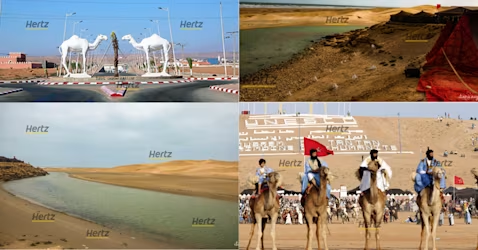
Two enormous white dromedary statues greet you at the entrance to Tan-Tan. The tone is set immediately. This is a long way from the polished medinas of the north.
Wandering through the souks means stepping into the daily life of the Moroccan south: spices, babouches, Sahrawi textiles, and locals going about their business with little interest in your presence. The Sunday souk is particularly lively. Late afternoon, once the worst of the heat has passed, is when the town truly wakes up: cafés fill, alleyways come back to life, and the pace that the midday sun had suspended quietly resumes.
Tan-Tan Plage (El Ouatia)
Twenty-five kilometres from town, Tan-Tan Plage feels like an entirely different world. The fishing port, one of the most active in the south of Morocco, gives the place a particular kind of energy: rough-edged, purposeful, genuinely real. Kids love watching the boats come in loaded with the day's catch.
The beaches stretching out from here are long, wild, and nearly empty. The Atlantic swells draw surfers, and the sunsets over the ocean are the kind that make you put your phone away. For families, it makes a great base, with swimming possible when conditions allow.
The Moussem of Tan-Tan
This is the region's signature event and, for many, one of the most extraordinary cultural experiences Morocco has to offer. The Moussem is a vast gathering of Saharan nomadic tribes, drawing more than thirty tribes from across the deep south. Horse races, traditional dances including the hypnotic Guedra, jaimas (large tents made from camel or goat hide) pitched across the site, and an atmosphere so far removed from ordinary life it genuinely raises goosebumps.
Recognised by UNESCO in 2008 as an Intangible Cultural Heritage of Humanity, the Moussem typically takes place between May and June. If your timing works out, clear your schedule.
The Surrounding Area
The countryside around Tan-Tan is an open invitation to explore. Khenifiss National Park, strung along the coast between Tan-Tan and Tarfaya, is one of Morocco's best-kept secrets: desert, ocean, and the country's largest coastal lagoon, Naïla, which hosts over 20,000 migratory birds at a time. Flamingos, cormorants, ducks, an entirely unexpected birdwatching safari, in the middle of the Sahara.
Thirty kilometres to the east, the Ouin Medkour oasis offers a welcome patch of green after the surrounding arid expanses. And for anyone with an interest in archaeology, the Elkhloua caves and the prehistoric rock paintings at Azguerre, further south, open a window onto a history that goes back far further than any of this.
Planning Your Visit
Getting there: The drive from Agadir is the recommended approach, and for good reason. Tan-Tan also has a small airport with charter connections. CTM and Supratours buses serve the town from both Agadir and Marrakech.
Where to stay: Accommodation is simple but perfectly adequate. In town, the Sables d'Or, the Bir Azzarane and the Al Medina are solid options. At Tan-Tan Plage, the choice widens slightly, with a handful of seafront properties.
Best time to visit: Winter offers the most comfortable temperatures. For the Moussem, aim for May or June. In July and August, the heat is brutal and sandstorms are a real possibility.
Budget: Tan-Tan is a genuinely affordable destination, noticeably cheaper than Agadir or Marrakech, and desert excursions remain accessible.
Safety: The town is calm and poses no particular concerns. For desert excursions, always go with a local guide, carry more water than you think you'll need, and let your accommodation know your plans. On the beaches, the Atlantic swells can be powerful: worth keeping a close eye on children near the water.
Tan-Tan is not a destination for everyone, but it is absolutely a destination for the right kind of traveller. The curious ones. Those looking for something other than the well-worn circuit. Families who want to show their children a Morocco that exists well beyond the organised tours and tourist-facing medinas.
Desert, ocean, nomadic culture, the Moussem. Tan-Tan holds all of it. It just asks that you give it a chance.
Register
By entering your email address, you agree to receive our newsletters by email and you are aware of our Privacy Policy.