Tiznit, an Oasis City South of Agadir
Some cities you drive through without stopping. Others you regret not having visited. Tiznit belongs firmly in the second category.
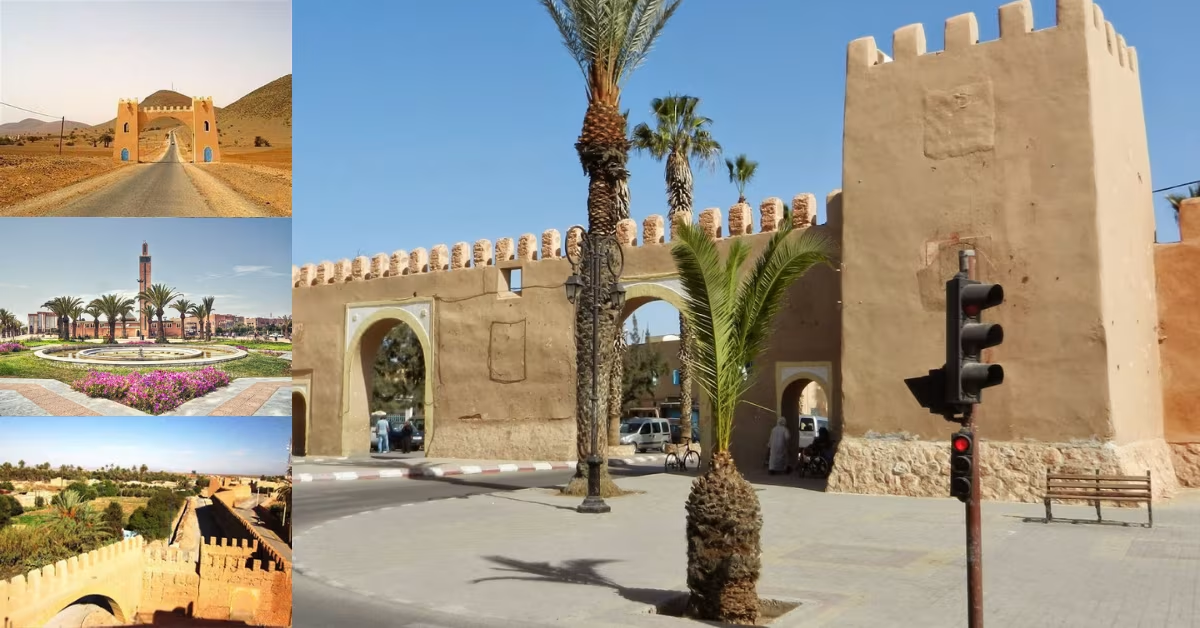
Caught between the foothills of the Anti-Atlas and the Atlantic coast, an hour south of Agadir, Tiznit is a city that lives on its own terms. It does not need to sell itself, and it welcomes visitors with that quiet, sincere Berber hospitality that is harder to find than it should be. It is not spectacular in the way that photographs well on social media. It is better than that. It is a real city, with a strong identity, craftsmen who still work the old way, terracotta ramparts that glow red in the evening sun, and a reputation that is well earned across all of Morocco for the quality of its silver jewellery.
If you are in southern Morocco and wondering whether to make the detour, stop wondering.
Tiznit in Brief: History and Character
The origins of the city
Tiznit is a relatively young city by Moroccan historical standards. It was founded in 1882 by Sultan Moulay Hassan I, who was looking to unify and pacify the Berber tribes of the south under central authority. Before that, there was little here beyond a spring, a few scattered tribes, and a legend.
The legend is worth knowing. Lalla Tiznit, according to local tradition, was a repentant woman, a former sinner turned saint, who is said to have made a spring rise from the earth at this spot before she died. The city carries her name, the spring is still there, and her memory is honoured in the grand mosque beside the basin. For children, it is the kind of story that holds attention far more effectively than any information panel.
The city also played a role in resistance to the French Protectorate. In 1912, Ahmed El Hiba, known as the "blue sultan," was proclaimed sultan here by the tribes of the south before marching on Marrakech. The episode was brief, but it remains firmly embedded in the collective memory of the region.
A Berber city of the south
Tiznit is Amazigh to its core. The language, the faces, the clothing, the jewellery worn by women at the market: everything here is a reminder that you are in the deep south, well away from standardised tourist circuits and medinas turned into open-air theme parks.
The atmosphere is that of a city functioning primarily for its own residents, which allows visitors to slip in quietly and on their own terms. The cafes are full of men playing cards, the souks smell of spices and hot metal, and nobody corners you at the medina entrance to offer a guided tour you did not ask for.
What to See and Do in Tiznit
The medina and its ramparts
Tiznit's ramparts are among the finest in Morocco, and they remain far less visited than those of Marrakech or Essaouira. Built in pisé, the ancient technique that combines earth, straw and water, they run for nearly five kilometres around the old city, punctuated by several monumental gates, the most impressive of which is Bab Oulad Jerrar.
Walking along the ramparts in late afternoon, when the low light shifts the pisé from ochre to deep red, is one of those simple, free experiences that stay with you long after a trip has ended.
Inside, the medina is compact and easy to navigate without a guide, which makes it ideal for families with children. The lanes are broad, the residents are accustomed to visitors without being overwhelmed by them, and you can wander freely without ever feeling genuinely lost.
Berber silver jewellery: the soul of Tiznit
This is what Tiznit is known for throughout Morocco, and justifiably so. It is, without serious competition, the country's capital of Berber silver jewellery, and the craftsmen's souks are the city's main draw.
In the workshops open to the street, you can watch artisans working metal by hand: hammering, engraving, soldering, setting coloured resin or semi-precious stones using techniques passed down through generations. It is genuinely absorbing to watch, educational for children, and it tends to lead naturally to purchases, which is no bad thing.
What you will find here: solid silver bracelets, multi-strand Berber necklaces, traditional fibulas used to fasten djellabas, engraved rings, earrings. The quality is generally good, the prices are fair, and bargaining is expected but never aggressive. One piece of advice: avoid the shops right at the medina entrances, which cater to tourists in a hurry, and head instead for the workshops in the inner lanes, where prices reflect actual craftsmanship.
The Lalla Tiznit spring and the grand mosque
At the heart of the medina, the Lalla Tiznit basin is the city's symbolic starting point. The water is still there, surrounded by a small shaded area where locals come to rest. The grand mosque beside it is one of the oldest in the city, recognisable by its distinctive minaret decorated with green ceramic tiles and ostrich eggs at the summit, symbols of purity in Islamic tradition.
The interior of the mosque is reserved for Muslims, but the exterior and surrounding area are well worth a look, and the whole neighbourhood around the basin makes for a pleasant walk.
Where to Sleep and Eat
Accommodation
Tiznit offers a modest but genuinely good selection of accommodation, concentrated mainly within the medina in the form of guesthouses and small riads. Value for money is excellent, noticeably better than in the major tourist destinations further north, and owners tend to be attentive and welcoming.
Families will find guesthouses with spacious rooms or family suites with access to a rooftop terrace. Couples will find small riads with interior courtyards and a Moroccan breakfast included, which is consistently a good choice. Solo travellers or those on tighter budgets will find simple, clean hotels around the main square.
Book ahead if you are coming on a weekend or during July and August.
Food and what to try
Southern Moroccan cooking is generous, fragrant, and quite different from what you eat in Marrakech or Fez. In Tiznit, a few things are worth seeking out.
Amlou is essential. This local spread, made from roasted almonds, argan oil and honey, is eaten at breakfast on fresh bread or warm msemen. It is rich, gently sweet, faintly nutty, and children almost always ask for more.
Mechoui, slow-roasted lamb cooked in a wood-fired oven, is served in certain medina restaurants on Fridays and during celebrations. If you encounter it, order it without hesitation. The Berber couscous served on Friday lunchtimes in small local restaurants is another way to eat very well and very locally for very little.
Go for the places with no official signage, identifiable by the smoke coming from the kitchen and a clientele that is entirely local. That is where you will eat best.
Practical Information
Getting to Tiznit
Tiznit is around 90 kilometres south of Agadir, roughly an hour on a well-maintained main road. From Marrakech, allow approximately four hours by car via Agadir. From Mirleft, it is thirty minutes heading north.
A car is the most practical option, particularly if you plan to explore the surrounding area. Bus connections exist from Agadir and Marrakech via CTM and Supratours, with stops at Tiznit's bus station, which is conveniently located at the entrance to the city.
On the ground
Allow one to two nights to visit Tiznit comfortably, or half a day if you are passing through on the coastal road. The Thursday weekly market is not to be missed if your visit coincides with it: farmers and craftsmen from the surrounding villages come down to sell their produce, and the atmosphere is lively and entirely genuine.
Bring cash. ATMs exist but are not plentiful, and most shops and artisans do not accept cards. Mobile coverage is good in the city. The medina is pushchair-friendly on the main routes, though some of the secondary lanes are narrow and cobbled.
What to See Around Tiznit
Tiznit makes an excellent base for exploring this part of southern Morocco, and the surrounding area has plenty of strong options within two hours' drive.
Aglou Plage is the nearest beach, fifteen minutes away by car. Wild and rarely busy, with cliffs and a fishing village, it offers a simple, restorative coastal break that works well as an afternoon between visits.
Mirleft, thirty minutes to the south, has cliff-framed beaches and the feel of a preserved Atlantic village. A natural next stop if you are heading further south.
Sidi Ifni, an hour's drive away, is the former Spanish enclave with its pastel art deco buildings: surprising, melancholy, and worth half a day.
Tafraoute, around two hours inland, is a Berber village set among a landscape of pink granite boulders, surrounded by palm trees and almond groves. The drive to get there is spectacular in itself, and the village is one of the finest in the Anti-Atlas. The famous painted rocks created by artist Jean Vérame in the 1980s, boulders spray-painted in bold colours across the natural landscape, are a curiosity that tends to go down well with children.
Souss-Massa National Park, an hour to the north toward Agadir, is a natural sanctuary where you can spot the northern bald ibis, a critically endangered species, alongside flamingos and numerous migratory birds. An ideal nature outing for families.
Agadir, an hour to the north, remains the practical regional hub for international flights, larger shops, and medical facilities if needed.
Tiznit does not try to charm you. It does not need to.
It is a city that has existed for over a century with a clear identity, a living craft tradition, and a quiet dignity that earns respect. For travellers looking to step outside the standard circuits without stepping into discomfort, it offers exactly what a good travel stop should: something genuinely enriching, something accessible, and enough authenticity to leave with something real.
Make it a stop on your southern Morocco itinerary. Buy a silver bracelet from a craftsman, eat mechoui on a Friday, walk the ramparts at sunset. Tiznit asks a little of you, and it gives back considerably more.
Register
By entering your email address, you agree to receive our newsletters by email and you are aware of our Privacy Policy.