Spider: A Challenging Surf Spot Near Agadir:
Morocco has become an essential destination for surfers worldwide, and the coastline between Agadir and Taghazout boasts some of the finest waves in the country. Among them, Spider holds a special place. This is not the kind of wave that appears in tourist brochures, nor is it one recommended to beginners taking their first lesson. Spider is a powerful right-hander that breaks over a rocky reef, a demanding spot that does not forgive mistakes and attracts experienced surfers seeking serious thrills.
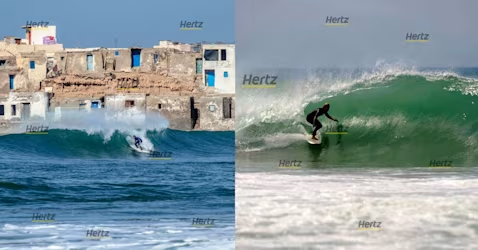
Spider: An Overview of the Spot
Spider is located on Morocco's Atlantic coast, between the villages of Taghazout and Tamraght, approximately twenty kilometres north of Agadir. This stretch is renowned for the quality of its waves, with around a dozen spots concentrated within just a few kilometres, yet Spider stands apart due to its technical nature and more intimate atmosphere.
The origin of the name is subject to several theories. Some point to the shape of the surrounding rocks, whilst others speak of a natural spider's web pattern formed by seaweed at low tide. The truth remains uncertain, and that is part of the mystique.
What is certain, however, is the nature of the wave itself. Spider is a reef break, meaning the waves break over a rocky bottom rather than sand. In practical terms, this produces a long, hollow right-hander with a committed take-off and fast sections that demand quick reflexes and precision. When conditions align, the wave can peel for several dozen metres, delivering incomparable sensations to surfers capable of reading it correctly.
However, this quality comes at a price. The rocky bottom is shallow in places, currents can be treacherous, and the take-off often occurs amid exposed rocks. A poorly managed wipeout can have painful consequences, and this is not a figure of speech. Spider is not a spot for the reckless or for those who overestimate their abilities.
Ideal Conditions for Surfing Spider
Like most spots in the region, Spider works primarily during the winter season, from September to March, when Atlantic swells strike the Moroccan coast with regularity. It is during this period that the waves reach their full potential and conditions are most consistent.
The ideal swell direction is northwest to west. With a southerly swell, the spot is less favourably exposed and wave quality diminishes. In terms of size, Spider begins to function properly from around one and a half metres of swell, but it is between two and three metres that the wave truly reveals its character, with well-formed walls and occasional barrels for those who know where to look.
Wind is a crucial factor, as with any spot. Optimal conditions occur with offshore wind, blowing from land to sea, typically from an easterly or south-easterly direction. This wind smooths the wave faces, hollows out the lips and creates perfect surfing conditions. Conversely, an onshore wind renders the waves soft and disorganised. One might as well stay in bed.
Regarding the tide, Spider works best at mid-tide, whether rising or falling. At high tide, the wave tends to back off and loses its power. At low tide, the rocky bottom becomes overly exposed and the risk of contact with rocks increases significantly. Consulting tide tables before entering the water is an essential habit.
Crowd levels at Spider remain moderate compared to neighbouring spots such as Anchor Point or Panoramas, which attract international crowds as soon as conditions improve. It is not that Spider is a secret, far from it, but its difficulty naturally deters a portion of surfers. Those who venture out generally know why they are there, which creates a more respectful atmosphere in the water.
Who Is This Surf Spot For?
Let us be clear from the outset: Spider is not a spot for beginners, nor even for intermediate surfers looking to progress. This is a wave intended for experienced practitioners, comfortable in challenging conditions and capable of reading a complex line-up.
The risks are genuine. The rocky bottom means that a fall can result in a brutal encounter with the reef, particularly in the shallow zones near the take-off. Currents, though rarely violent, can catch out those unfamiliar with the spot and complicate the return to the peak. And then there is the wave itself, fast and powerful, which allows little time for hesitation once you are committed.
Before venturing to Spider, you should have mastered several fundamentals: an efficient duck dive to get through the sets, a rapid take-off on hollow waves, the ability to read currents and sets, and above all the capacity to remain calm when things do not go according to plan. If you have the slightest doubt about your level, there are dozens of more accessible spots in the region where you can progress safely before returning to attempt Spider.
For non-surfing companions or the merely curious, the spot is easily observed from the coastal road or the surrounding rocks. It is quite a spectacle when conditions come together and experienced surfers link manoeuvres on these perfectly formed walls of water. Children and families can enjoy the view without putting themselves at risk, and there are beaches far better suited to swimming just a few minutes' drive away.
Preparing Your Session: Practical Information and Advice
How to get there? From Agadir, take the coastal road heading north towards Taghazout. Spider is situated between Tamraght and Taghazout, approximately twenty-five minutes' drive depending on traffic. The spot is visible from the main road, and you will easily notice the cars parked along the roadside when conditions are good. From Taghazout itself, it is barely five minutes by car or around fifteen on foot if you walk along the coast.
Parking and water access? There is no official car park, just informal spaces along the road. Park in a manner that does not obstruct traffic and leave nothing visible in your vehicle; thefts are rare but not unheard of. Access to the water is via the rocks, which requires some care, particularly when carrying a board under your arm. Observe the path used by locals and follow it; they know the safest routes.
What board, what wetsuit? For Spider, a classic shortboard or a slightly more voluminous fish will suffice, depending on your style and the day's conditions. Avoid longboards, which are ill-suited to the wave's power and speed. Regarding wetsuits, a 3/2 is generally adequate from September to November and from March onwards, but bring a 4/3 for the winter months, as the water can drop to around 17-18 degrees and sessions often last longer than anticipated.
Surf shops and schools nearby? Taghazout is replete with surf shops where you can hire equipment, purchase wax or have a damaged board repaired. Several surf schools also offer lessons for all levels, though none will take you to Spider if you are a beginner, and rightly so. If you wish to improve before tackling this spot, local instructors will guide you towards waves suited to your level.
Where to eat and relax after your session? Taghazout is the ideal base camp, with numerous cafés and restaurants facing the ocean where you can put the world to rights over a tagine or a fresh orange juice. Tamraght, slightly further south, offers a quieter atmosphere and less touristy establishments. In either case, prices remain reasonable and the welcome is warm, particularly if you share a few words about the session you have just experienced.
Six Other Surf Spots to Discover in the Region
The coast between Agadir and Taghazout is a veritable playground for surfers, with spots for all levels spread across some fifteen kilometres. Here are six alternatives to Spider, whether you are seeking an additional challenge or a more accessible wave.
Anchor Point: the most famous spot in the region, and arguably one of the finest right-handers in Morocco, if not Africa. A long, perfect wave that can peel for several hundred metres when conditions are optimal. Confirmed level required, and expect to share the peak with surfers from around the world.
Panoramas: adjacent to Anchor Point, a slightly shorter right-hander but equally high quality, with a more accessible take-off. This is often where surfers retreat when Anchor is too crowded or too large. Intermediate to advanced level.
Killer Point: the name does not lie; this is a powerful spot reserved for experts. A right-hander that breaks over sharp rocks, with tubular sections when the swell is substantial. Best avoided if you lack solid reef break experience.
Hash Point: more accessible than its neighbours, Hash Point offers a long, forgiving right-hander, ideal for intermediate surfers wishing to experience quality waves without taking excessive risks. The take-off is relatively straightforward and the wave forgives errors.
La Source: a beach break with varied waves, perfect for beginners and intermediates. The atmosphere is relaxed, surf schools bring their students here, and it is a fine place to enjoy yourself without pressure.
Banana Beach: as the name suggests, a banana-shaped beach with waves accessible to all. This is the quintessential family spot, where children can learn in complete safety whilst parents enjoy the sunshine. Unlike the frenzy of spots such as Anchor Point or the technical challenges of Imsouane further north, here one takes one's time and simply has fun.
Why Spider Is a Legendary Spot
Spider is not a wave that yields easily, and that is precisely what makes it so appealing. For experienced surfers seeking an adrenaline rush, this spot delivers everything one could hope for: a powerful right-hander, a wild setting and memorable sessions.
Whether you are ready to paddle out or prefer to observe from the rocks whilst awaiting the necessary skill level, one thing is certain: Spider leaves no one indifferent.
Register
By entering your email address, you agree to receive our newsletters by email and you are aware of our Privacy Policy.