Explore the Ancient Ruins of Volubilis in Morocco
A Site That Changes the Way You See Morocco
Most first-time visitors to Morocco arrive thinking medinas, desert, and spices. Understandably so. But Morocco is also two thousand years of layered history, and nowhere makes that clearer than Volubilis.
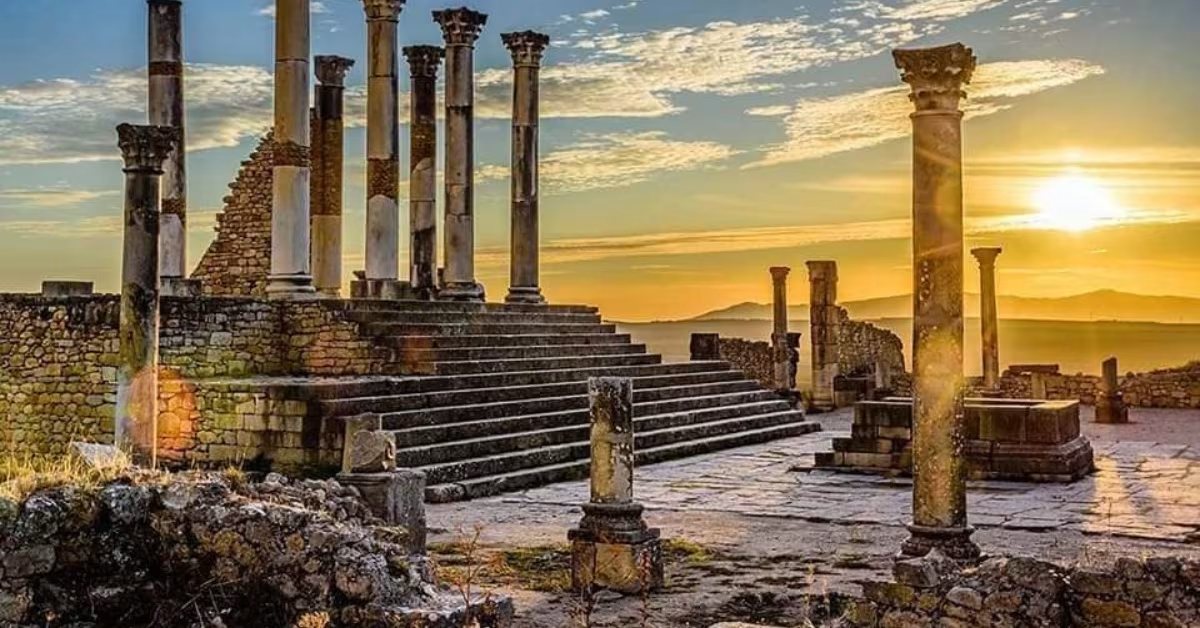
Picture Roman columns standing in open Moroccan countryside, intact mosaic floors laid down in the second century still sitting exactly where they were placed, and a deep quiet broken only by the occasional wind. That's Volubilis. A UNESCO World Heritage archaeological site, routinely underestimated by visitors in a hurry, and one of the most genuinely impressive places in the country.
A Bit of Background: What Is Volubilis?
Volubilis is an ancient Roman city, though its story starts well before Rome arrived. The site was already inhabited by Berber communities centuries before the common era, which makes it something remarkable: a place of continuous human presence, where civilisations succeeded one another without entirely erasing what came before.
The city reached its peak between the first and third centuries AD, when it became one of the most significant urban centres in the Roman province of Mauretania Tingitana, roughly corresponding to northern Morocco today. At its height, Volubilis was home to tens of thousands of people, with temples, bathhouses, a forum, triumphal arches, and private residences decorated with mosaics of extraordinary refinement.
Rome eventually withdrew. The city carried on, then slowly declined, before being partly destroyed by the 1755 earthquake, the same one that levelled Lisbon. What remains today is still enough to stop you in your tracks.
UNESCO listing in 1997 brought protection and serious investment in the site. For visitors, that means controlled access, ongoing archaeological excavations, and a level of presentation that actually helps you understand what you're looking at.
What You Come to See
Volubilis covers around 40 hectares, which makes it a generous, expansive site that can't be rushed through in twenty minutes. Budget at least two hours, more if you're the kind of person who likes to actually look at things.
The Triumphal Arch is the most photographed monument on the site, and it earns that status. It stands alone in the landscape, largely intact, carrying a quiet authority that's hard to shake. Built in 217 AD in honour of Emperor Caracalla, it has become the defining image of Volubilis, the one on every brochure.
The Capitol and the Basilica form the civic and religious heart of the ancient city. The Capitol was dedicated to the Roman triad of Jupiter, Juno, and Minerva. The columns still standing give you a genuine sense of the scale and ambition of the original building.
The Baths of Gallienus are a reminder that Romans, wherever they settled, always built their bathhouses first. A set of priorities that's hard to argue with.
But the real treasure at Volubilis is the mosaics. Preserved in situ, meaning left in their original positions within the private houses where they were laid, they depict mythological scenes, animals, and geometric patterns with a precision and vividness of colour that genuinely takes your breath away. The House of Orpheus, the House of the Labours of Hercules, the House of Dionysus and the Four Seasons: each is named after the mosaics it contains, and each one deserves a proper pause.
Practical Information
Volubilis sits about 30 kilometres north of Meknes and roughly 60 kilometres west of Fes. It's one of the easiest excursions to organise from either city, whether you go by shared taxi, rental car, or with a private guide.
From Meknes, a grand taxi takes around 45 minutes. From Fez, allow an hour and a half by car. Local agencies offer combined circuits taking in Volubilis, Meknes, and Moulay Idriss, which is a smart way to get the most out of a full day.
The site is open every day from sunrise to sunset. Entry fees are modest, a few euros per person. Children under 12 are usually admitted free or at a reduced rate; check current prices before you go.
Official guides are available at the entrance and are genuinely worth hiring. Without one, it's easy to walk straight past something extraordinary without realising it. The history of the site is layered and rich, and a good guide turns an archaeological walk into something closer to time travel.
Tips for Visiting
When to come. Spring, between March and May, is the best time. The surrounding countryside is green, temperatures are comfortable, and the late afternoon light on the columns is almost unreasonably beautiful. Summer can be punishing on this largely exposed site, with very little shade.
What to bring. A hat, sun cream, and solid walking shoes. The ground is uneven, some stones are slippery, and you'll cover a lot of distance. Bring more water than you think you need, especially with children.
Visiting with kids. Volubilis works well as a family outing, as long as you do a little preparation beforehand. Tell the kids something about Roman history before you arrive, show them pictures of mosaics, and frame it as exploration rather than a guided tour. The site is open and spacious, children can move freely through the marked areas, and that freedom makes a real difference to how they experience it.
A few things worth knowing. The site offers almost no shade, so don't underestimate sun exposure even in cooler months. And try to avoid mid-morning, when large tour groups tend to arrive from Fes and Meknes simultaneously.
What to Do Nearby
Meknes: Consistently overshadowed by Fes and Marrakech, Meknes is nevertheless one of Morocco's four imperial cities and deserves at least half a day. Its medina is UNESCO-listed, the atmosphere is calmer than Fes, and landmarks like the monumental Bab Mansour gate are genuinely impressive. It's also the most logical base for a visit to Volubilis.
Moulay Idriss Zerhoun: Perched on twin hills a few kilometres from Volubilis, this holy city is one of the most sacred sites in Morocco. It holds the mausoleum of Moulay Idriss I, founder of the country's first Arab dynasty. The visit is respectful and genuinely moving, and the views from the upper part of the village make the climb worthwhile on their own.
Fes: An hour's drive away, Fes is an essential stop on any itinerary through northern Morocco. Its medina, the largest living medieval medina in the world, is a labyrinth you can get happily lost in for hours. The tanneries, the madrasas, the souks: Fes is a destination within a destination.
The Middle Atlas countryside: The landscape around Volubilis is rolling and agricultural, with a quiet beauty that surprises visitors who arrived expecting Morocco to look like the south. Green hills, cultivated fields, unhurried villages: a very different side of the country.
Ifrane: Often called the "Swiss town of Morocco," Ifrane sits at altitude about two hours away, with chalets, cedar forests, and temperatures that stay genuinely cool even in summer. It's a curiosity worth knowing about, and an unusual option for families looking for something different.
Volubilis is the kind of place that quietly recalibrates your sense of scale. You arrive in Morocco for the souks and the dunes, and you leave with two-thousand-year-old Roman mosaics lodged somewhere permanent in your memory.
It deserves far more attention than it typically gets, and it fits naturally into any itinerary that takes in Fes and Meknes. Don't skip it.
Register
By entering your email address, you agree to receive our newsletters by email and you are aware of our Privacy Policy.