The Historic Ramparts of Rabat
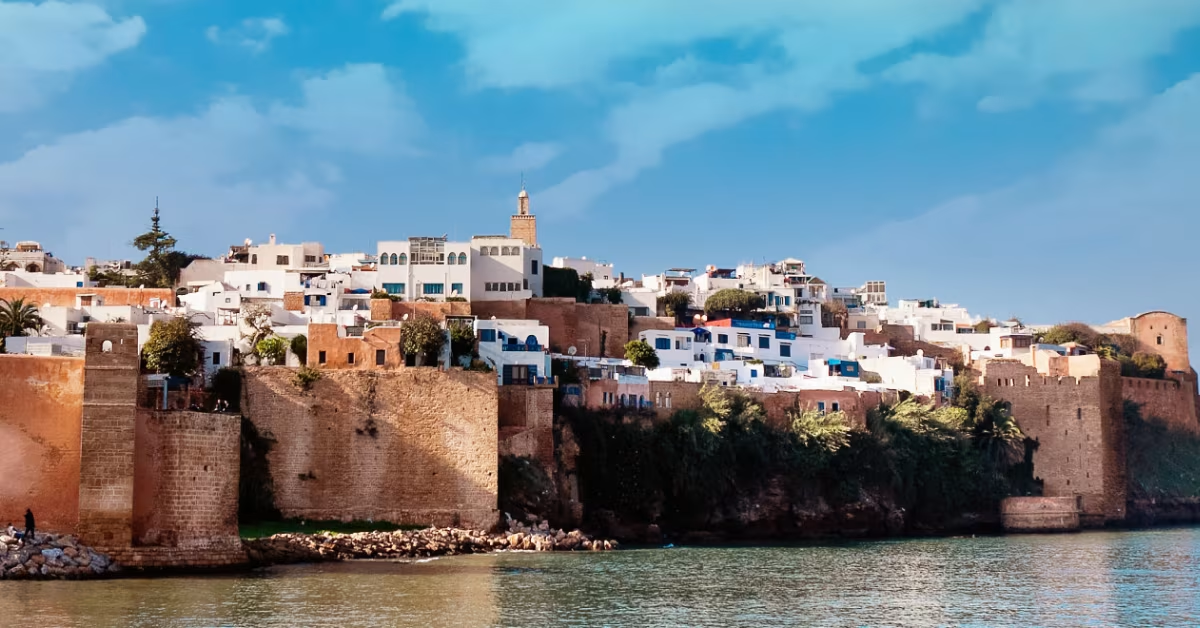
Rabat doesn't always make it onto the shortlist when people plan a trip to Morocco. Yet the country's capital holds surprises that most visitors never expect. Its maritime ramparts are the most compelling proof of this: imposing fortifications standing face to the Atlantic, carrying several centuries of history without needing a single guided tour to leave an impression. It's the kind of place you arrive at to look at the sea, and end up lingering far longer than planned.
A Bit of History
Rabat's ramparts didn't appear by accident. Their construction dates primarily to the 12th century, under the Almohad sultan Yacoub Al-Mansour, who wanted to turn Rabat into a powerful military capital capable of controlling the Bou Regreg estuary and defending the city against seaborne invasion. At the time, Rabat was still known as Ribat Al-Fath, meaning "the camp of victory", a name that sets the tone rather well.
The Almohads were serious builders. They also gave us the Hassan Tower, whose construction began in the same period, along with the Koutoubia in Marrakech and the Giralda in Seville. The ramparts were part of a sweeping architectural programme designed to last for centuries, and it's fair to say that ambition paid off.
By the 17th century, the ramparts took on a very different role. Rabat had become a haven for corsairs, the state-sanctioned pirates who terrorised the Mediterranean and Atlantic shipping lanes, and the fortifications served as much to organise maritime raids as to protect the city. The Republic of Bou Regreg, as it was known, was a near-independent entity feared by the naval powers of Europe. A considerably less tame history than the stones might suggest today.
Rabat's historic ensemble, ramparts included, has been listed as a UNESCO World Heritage Site since 2012. That's not a footnote: it's international recognition that this is a site genuinely worth the journey.
What You'll See
Fortifications facing the ocean
The first thing that strikes you is the scale. The ramparts stretch for several kilometres, lined with watchtowers, bastions and arrow slits that give a visceral sense of what defending a coastal city once demanded. The ochre stone, worn by centuries of salt air and Atlantic spray, takes on particularly beautiful tones as the day winds down.
Sweeping views over the Atlantic and Salé
From the highest sections of the ramparts, the view out over the Atlantic is wide open and genuinely breathtaking. Across the Bou Regreg river, you can also make out Salé, Rabat's twin city, its minarets and whitewashed rooftops cutting a clean silhouette against the sky. It's a rare double panorama, caught between river and ocean, that very few Moroccan cities can offer.
A coherent architectural ensemble
The ramparts don't stand alone. They form part of a monumental whole that includes the Hassan Tower, an unfinished 12th-century minaret, and the Mohammed V Mausoleum right alongside it, whose white marble provides a striking contrast to the austerity of the fortifications. Everything is within walking distance, which makes the visit remarkably easy to organise.
Walking the Ramparts
The good news is that the ramparts are free to walk, with no particular restrictions. The most enjoyable route follows the fortifications from the Kasbah of the Udayas all the way to the Hassan Tower, taking in viewpoints over both the river and the ocean along the way.
Set aside about an hour and a half for a relaxed stroll without rushing. With children, allow a little more: the nooks, staircases and ancient stonework tend to generate plenty of questions, which is really no bad thing.
The Kasbah of the Udayas, right at the end of the route, is an essential stop. Its blue-and-white lanes, Andalusian gardens and terrace overlooking the ocean make it one of the most photogenic corners in all of Rabat, if not the entire Moroccan Atlantic coast.
Practical Information and Tips
Getting there: The ramparts are walkable from central Rabat. By taxi, ask for the Kasbah of the Udayas or the Hassan Tower and you'll be dropped off within a few minutes' walk. There's no entrance fee for walking along the outer ramparts.
How long to allow: Between an hour and a half and three hours, depending on your pace and whether you continue on to the Kasbah or the Mausoleum.
Best time to visit: Rabat is pleasant year-round thanks to its Atlantic position, but spring and autumn offer ideal temperatures for walking. In summer, aim for an early morning or late afternoon visit to avoid the midday heat.
Light and photography: For photos, the evening golden hour is hard to beat. The ochre stone of the ramparts practically glows under low-angled light, and the view over the ocean gains remarkable depth. Plan to be in position about an hour before sunset.
What to wear: The ramparts are entirely outdoors, so there are no particular dress requirements. If you're continuing on to the Kasbah or other enclosed sites, modest, non-provocative clothing is advisable, as it is throughout Morocco.
General awareness: Rabat is a relatively calm and safe capital for tourists, but keep an eye on your belongings in busy areas, especially during high season.
What to See Nearby
The ramparts are just a starting point. Rabat is a city dense with heritage, and everything around them is worth taking the time to explore properly. Here are the key stops in the area.
The Kasbah of the Udayas is literally at the end of the ramparts. It's the natural continuation of the visit and well worth it: blue-and-white painted lanes, an Andalusian garden, and views out over the estuary.
Rabat's medina is just steps away. Calmer and less overwhelming than those of Fès or Marrakech, it's an ideal first introduction to the world of the souks without the sensory overload.
The Mohammed V Mausoleum and the Hassan Tower can be visited together, free of charge, and together form one of the most impressive sites in the capital. The royal guard in traditional dress stationed outside the mausoleum is a spectacle in itself, especially for younger visitors.
Rabat beach is a short taxi ride away. The Atlantic water stays cool even in summer, but the beach is a pleasant spot for a late-afternoon break after a long day on foot.
Rabat's maritime ramparts are the kind of site you approach with modest expectations and leave with the firm conviction that Morocco's capital deserved far more than a one-night stopover. History, architecture, ocean views and authentic neighbourhoods all within easy reach: everything is in place for a full, genuinely memorable day of exploration.
Register
By entering your email address, you agree to receive our newsletters by email and you are aware of our Privacy Policy.