
Mahkama of Pacha (Casablanca)
Everyone arrives in Casablanca with the Hassan II Mosque in mind. Fair enough. It is enormous, it is spectacular, and it earns every photograph taken of it. But Casablanca has more up its sleeve than its most famous landmark, and the Mahkama du Pacha is perhaps the finest proof of that.
Tucked inside the Habous quarter, this building is one of the most quietly extraordinary places in the city. Overlooked by rushed tourists, ignored by most generic travel guides, it rewards anyone willing to slow down. If you care about architecture, history, or simply places that have something to say, read on.
A Little History Before You Visit
The Mahkama du Pacha was built between 1941 and 1952, during the French Protectorate period. Its name translates directly as "tribunal of the Pasha," which is exactly what it was: a court of justice and official reception hall operating under the authority of the Pasha of Marrakech, T'hami El Glaoui.
El Glaoui is a figure worth knowing. A man of considerable power, a French ally, and a personality as admired as he was controversial in Moroccan history, he left a permanent mark on that era. The Mahkama is, in architectural terms, a direct expression of his ambition.
The building functioned simultaneously as a courthouse, an audience chamber, a reception venue, and an administrative office complex. It was, in practical terms, the nerve centre of local power in Casablanca. Part of it is still used by Moroccan administrative services today, which gives it a living, breathing quality that no museum can replicate.
The Architecture: A Masterclass in Moroccan Craft
Walking into the Mahkama du Pacha is a visual shock, and a very welcome one.
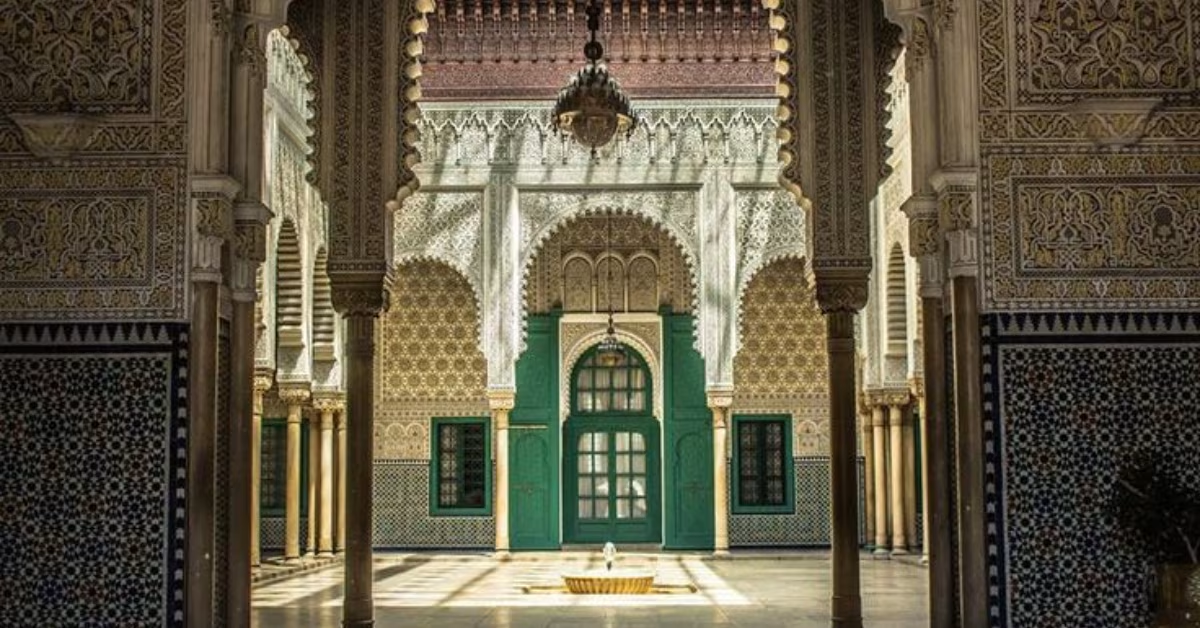
The building is a masterpiece of neo-Moorish and Arabo-Andalusian style. Behind those terms lies something very tangible: complex geometric patterns, hand-carved arabesques, warm colours, and noble materials working together in total harmony.
Here is what you will encounter, and what you absolutely should not rush past:
Zelliges. These small coloured ceramic tiles are cut and assembled by hand into geometric patterns of staggering precision. A master zellige craftsman spends years developing this skill. You will grasp its brilliance in seconds.
Sculpted stucco. The walls are covered in finely worked plaster, with floral and geometric motifs in relief. The detail is extraordinary, and every inch of it is handmade.
Atlas cedar wood. Ceilings, doors, and latticework screens are carved from cedar sourced in the Atlas Mountains. The faint scent of the wood mingles with the cool air of the courtyards in a way that stays with you.
Moucharabiehs. These ornate wooden grilles filter the light and cast shifting patterns of shadow across the floors. For photographers, this is a serious playground.
Interior courtyards. The building is organised around planted inner courtyards open to the sky, where natural light falls vertically onto the mosaics below. This architectural principle, rooted in Islamic tradition, produces spaces that are both functional and deeply calming.
What to See Inside
The Mahkama contains no fewer than 24 rooms, each distinct from the last. Every space is decorated according to its own theme or purpose, and the level of detail shifts from room to room, keeping the visit consistently engaging.
The great audience hall is the centrepiece. Tall-ceilinged and ornate from floor to ceiling, it gives you a precise sense of the grandeur with which dignitaries and officials were once received here. Stand in it and try to picture the formal delegations, the diplomatic dealings, the verdicts handed down in this extraordinary setting. History has a texture in this room.
Local guides tend to have strong stories about El Glaoui and his era: his excesses, his contradictions, his complicated legacy. If you find one, let them talk. Those stories give the place a depth that no information panel can provide.
One practical tip that makes a real difference: look up. The painted and sculpted cedar ceilings are often the most spectacular element in any given room, and visitors moving too quickly miss them entirely.
Planning Your Visit
Getting there. The Mahkama du Pacha is located in the Habous quarter, in the Hay Hassani district, south of Casablanca's city centre. The address is Place des Alaouites. From the centre, a petit taxi or grand taxi is the simplest option and takes roughly ten minutes depending on traffic. The Hassan II Mosque is about ten to fifteen minutes on foot, making it easy to pair both visits in a single half-day.
Opening hours. The Mahkama is generally open on weekday mornings. Hours can vary, so it is worth checking with your hotel beforehand, particularly around public holidays and Fridays.
Entry fee. Very affordable, and the visit is entirely suitable for families with children. The open courtyards give younger visitors space to breathe.
How long to allow. Between 45 minutes and an hour and a half, depending on your pace.
Best time to go. Early morning is ideal. The light is at its best, the building is quiet, and you can take your time with photographs before any groups arrive.
Do you need a guide? Not strictly, but it makes a meaningful difference. A local guide will explain the architectural symbolism, the history of the building, and the kind of details that simply are not written anywhere. You can arrange one on the spot or through your hotel.
Dress code. Dress modestly and respectfully, as you would in any official or heritage building in Morocco. This is not a mosque, but common sense applies.
The Habous Quarter: Stay a Little Longer
The Mahkama sits at the heart of the Habous, and the neighbourhood earns more than a passing glance.
The Habous is a medina built by the French in the 1930s in a neo-Moorish style, designed as a deliberate homage to traditional Moroccan architecture. The result is genuinely surprising: well-ordered laneways, neat arcades, the atmosphere of a medina without the sensory overload you find elsewhere. If you visited Fez and found the pace a little relentless, the Habous offers a more accessible version of that world without sacrificing authenticity.
The quarter has craft souks where you can pick up leatherwork, spices, babouches, and carved wooden objects. The Moroccan pastry shops here have a strong reputation, and stopping for a coffee with a gazelle horn or a honey briouat is absolutely worth the time.
Why This Place Is Worth Your Afternoon
The Mahkama du Pacha is not a museum. It has not been staged for tourists, and there is no souvenir shop at the door. It is a working building that has carried nearly a century of Moroccan history without losing any of its character.
That is precisely what makes it rare.
If this is your first visit to Casablanca, it would be a shame to leave with only the Hassan II Mosque in your memory. The Mahkama offers a different reading of the city: more intimate, more layered, more honest. It shows you what Casablanca hides when it is not playing the role of a mass-market destination.
Go. Take your time. Look up.