The Koutoubia Mosque: Marrakech's Constant
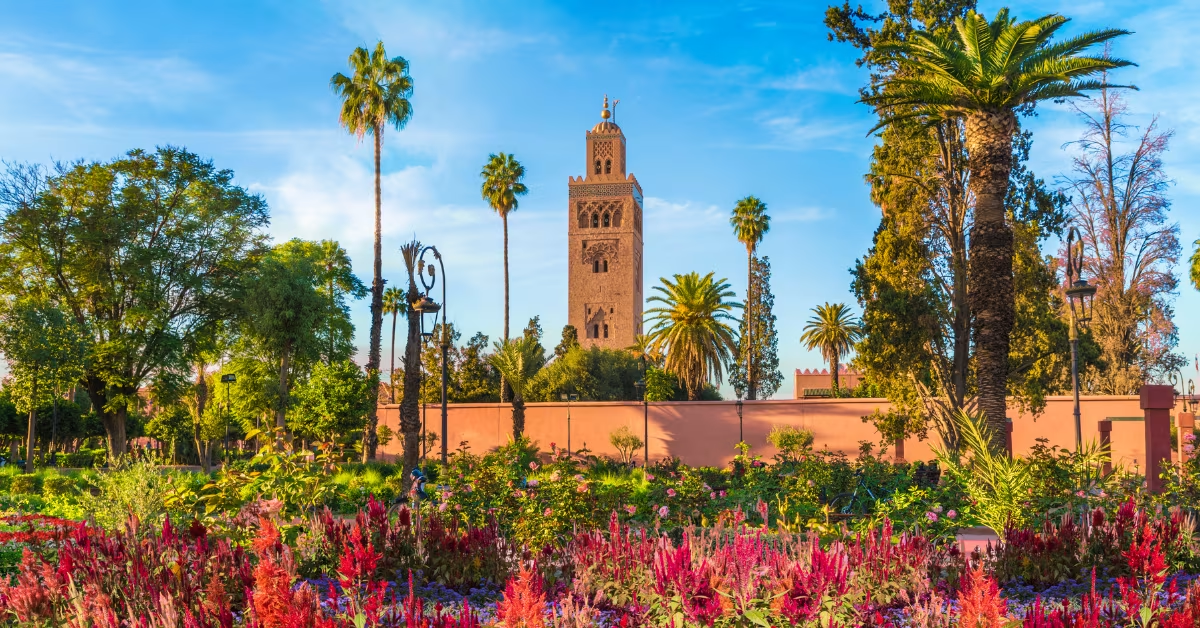
You can get thoroughly lost in the souks, wander in circles through the medina, or be completely swallowed up by the chaos of Jemaa el-Fna, and the Koutoubia will still be there. Rising 70 metres above the city and visible from almost anywhere within it, the minaret acts as a compass for everyone who has lost their bearings, which in Marrakech means more or less everyone at some point. It is the city's most iconic monument and quite possibly one of the finest surviving examples of medieval Islamic architecture anywhere in the world. And yet most visitors standing beneath it have very little idea what they're actually looking at.
A History Worth Knowing
The Koutoubia was built in the twelfth century under the Almohads, a Berber dynasty whose influence stretched across the Maghreb and deep into Andalusia. Here's something most people don't know: there are actually two mosques on this site. The first was constructed around 1147, and a second, slightly offset from the original, was built alongside it a few years later. Archaeologists have uncovered the remains of that first structure, and they're visible right there on the ground beside the current building if you know to look for them.
The name itself comes from the Arabic "koutoubiyine," meaning the booksellers. The neighbourhood surrounding the mosque was once home to dozens of merchants trading in books and manuscripts, a detail that speaks volumes about the cultural and intellectual weight Marrakech carried during that era.
The Koutoubia's influence didn't stay in Morocco. Its minaret directly inspired both the Giralda in Seville and the Tour Hassan in Rabat, two monuments built at roughly the same time by the same builders, three structures sharing a single architectural vision across two continents. It's the kind of connection that stops you in your tracks once you've made it.
The Architecture
The minaret is the centrepiece, and it rewards close attention. At 70 metres tall with a square base of 12.5 metres per side, its proportions follow a strict rule: height equals five times width. That ratio, characteristic of Almohad design, is what gives it such composed, unhurried verticality.
What makes it genuinely fascinating is that all four faces are different. Each one carries its own ornamental scheme, interlacing carved stonework, horseshoe arches, varying geometric patterns, all held together in a harmony that never feels busy or overwrought. Walk the full perimeter. It's worth every minute.
At the very top sit three gilded spheres known as the jamour. Legend has it that one was crafted from jewellery donated by the sultan's wife as penance for breaking her Ramadan fast. Whether or not that's true, the story has become part of the place, and that counts for something.
The garden surrounding the mosque is planted with rose bushes and orange trees and offers a genuinely pleasant place to decompress after a morning in the souks. Children have room to move, the pace is slower, and the noise of the medina feels a little further away than it actually is.
Visiting: What You Need to Know
Access : Non-Muslims are not permitted inside the mosque. This applies to the vast majority of mosques across Morocco, and the Koutoubia is no exception. There is no alternative entrance, no workaround worth looking for; simply respect the rule and appreciate what the exterior offers, which is already considerable.
Free to explore : The full exterior circuit, the gardens, and every angle of the minaret are open to everyone, free of charge, at any hour of the day. No ticket, no queue. In Marrakech, that kind of access is rare enough to be worth pointing out explicitly.
Best time for photos : Early morning is the clear winner. The light is soft, the crowds are thin, and at sunrise the minaret takes on a warm rose-pink tone that is as photogenic as anything the city has to offer. Late afternoon and sunset are also strong, with rich warm tones playing well against the ochre stone. Midday is the least rewarding on both counts: harsh overhead light and the highest concentration of visitors.
Dress and behaviour : The dress code outside is relaxed, but a respectful attitude matters, particularly during prayer times. Friday lunchtime draws a large gathering of worshippers, and the atmosphere around the mosque takes on a different quality altogether, solemn and quietly absorbing when observed from a respectful distance.
Getting your bearings : The Koutoubia sits about two minutes on foot from Jemaa el-Fna, which makes it a natural starting point for any day in Marrakech. Get your bearings here first, orient yourself by the minaret, and let the medina take over from there.
What's Close By
The Koutoubia makes a fine anchor, but the neighbourhood around it is generous. Within walking distance, or close enough, you have some of the best that Marrakech has to offer.
Jemaa el-Fna is literally steps away. The great square of Marrakech pulses from morning to well past midnight with storytellers, musicians, orange juice vendors and food stalls that materialise at dusk in a way that feels slightly theatrical and entirely genuine at the same time. Essential, especially on a first visit.
The Medina Souks begin just behind the square, where the labyrinth proper starts. The spice souk, the tanners' souk, the babouche souk, the lantern souk: every alley has its own specialism, and the best thing you can do is allow yourself to get lost. That's usually when the most interesting things happen.
The Mouassine Quarter, about ten minutes' walk from the Koutoubia, is one of the medina's most authentic neighbourhoods, with grand old residences, historic fountains, and a handful of well-judged concept stores and cafés that have settled into the old buildings without overwhelming them. It sits nicely between heritage and contemporary life.
The Koutoubia Gardens themselves are frequently overlooked in favour of the square next door, which is a mistake. They're a genuine pocket of calm, well-suited to a family pause between sightseeing, or simply to sitting on a bench in the shade of an orange tree and looking up at the minaret properly for once.
The Bahia Palace, around twenty minutes' walk east, is one of Marrakech's most beautiful nineteenth-century palaces, with shaded courtyards, interior gardens and rooms richly decorated in zellige tilework and carved plaster. It's well-preserved, accessible and well worth the detour.
Jardin Majorelle, roughly 3 km away and best reached by taxi or calèche, is the botanical garden made famous by Yves Saint Laurent, who owned it for decades. Its cobalt blue has become one of the most recognised colours in Moroccan tourism, and for good reason. Get there early, particularly in high season, as it draws serious crowds by mid-morning.
The Koutoubia is not simply a landmark to photograph and move on from. It is a fixed point, a reference, the quiet thread running through a day in Marrakech. It has been standing for nine centuries, and it has watched sultans, scholars, conquerors and countless millions of visitors pass beneath it. It will still be standing long after you've gone. Take a moment to actually look at it rather than just capturing it. It's the kind of monument that gives more to those who stop.
Register
By entering your email address, you agree to receive our newsletters by email and you are aware of our Privacy Policy.