Aït Ben Haddou: The Village That Time Built
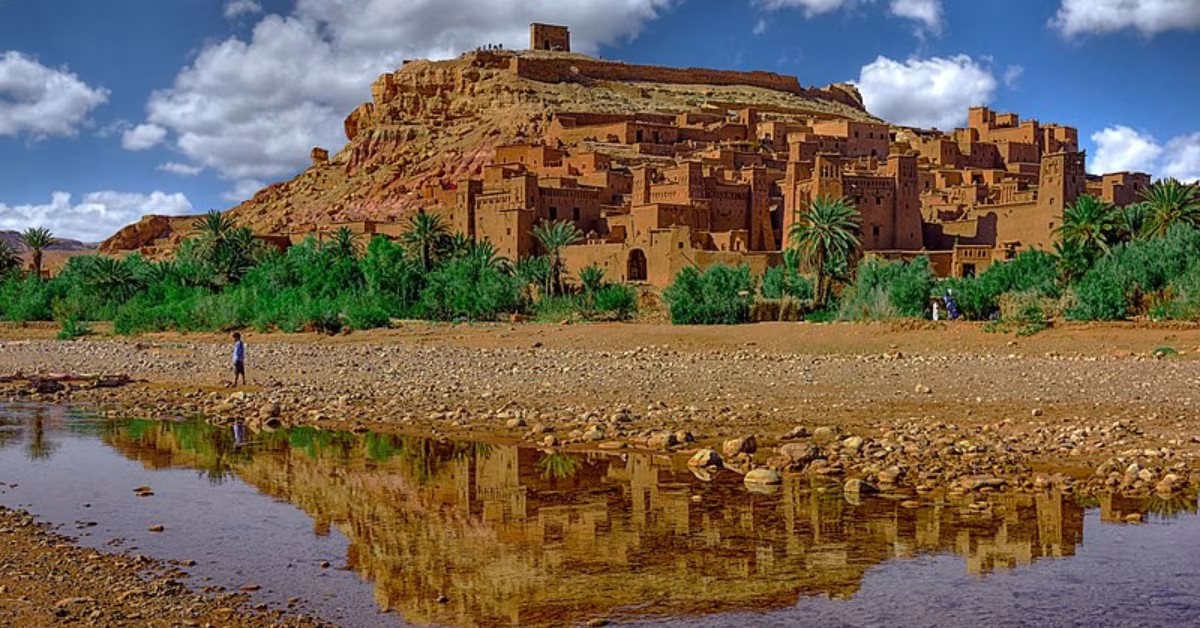
Some places need no introduction, and yet nothing quite prepares you for the first sight of Aït Ben Haddou. This fortified village of ochre earth, sitting beside a dry riverbed in the Drâa Valley, looks like something pulled from a very old dream. Towers stack upon towers, narrow lanes climb upward, and the mud walls seem less constructed than grown from the ground beneath them. It is beautiful. It is strange. And it is one of the most compelling sites Morocco has to offer. Listed as a UNESCO World Heritage Site since 1987, Aït Ben Haddou is as close to unmissable as the southern Moroccan desert gets.
What Aït Ben Haddou Actually Is
A ksar is a traditional fortified village, built to protect its inhabitants and their food stores from raiders and the elements. Aït Ben Haddou is one of the best-preserved ksour in Morocco, and almost certainly the most famous in the world.
Its construction dates back several centuries, most likely to the seventeenth century, though certain parts of the site are considerably older. The ksar once occupied a strategic position along the caravan route connecting the Sahara to Marrakech, a corridor along which salt, gold, spices and enslaved people all passed at various points in history. A crossroads of the world, lost in the middle of the desert.
What makes it singular is the pisé architecture: a hand-worked blend of raw earth, straw and water that has been shaped and reshaped by generations of builders. The houses, the collective granaries known as agadirs, and the corner towers form a coherent and harmonious whole whose colour shifts with the light, from pale beige in the morning hours to a deep burnt red as the sun goes down. UNESCO's recognition in 1987 was not a formality. It was an acknowledgement of something genuinely irreplaceable.
What to See and Do
Crossing the riverbed: To reach the ksar, you first cross the Oued Mellah, the watercourse running alongside the site. In the dry season this means stepping across stones laid in the riverbed, a modest but quietly theatrical entry that sets the tone for everything that follows. During wetter periods, a small dam provides a crossing point. It's a minor detail that contributes, somehow, to the feeling of stepping outside of ordinary time.
Exploring the ksar: Once inside, follow your instincts rather than a fixed route. The lanes climb, intersect and narrow unexpectedly. You'll come across houses mid-restoration, ancient granaries, carved wooden doors, and children playing in the dust. A handful of families still live within the ksar, and that continued human presence gives the place a living quality that many heritage sites lost long ago.
The view from the top: Make the climb. It's a moderate effort, manageable for children from about six or seven upwards, and the reward is considerable: a sweeping panorama across the valley, the palm groves, the snow-capped Atlas in winter, and the village below laid out like a map of itself. It's the photograph you'll keep.
The craftspeople: Throughout the visit, artisans offer Berber jewellery, pottery, rugs and carved woodwork. Quality varies, but certain pieces are genuinely worth a closer look. Take your time, engage with the people behind the stalls, and negotiate with good humour.
Aït Ben Haddou and the Movies
Most travel guides skim over this, which is a shame, because it's often what visitors find most surprising and most memorable. Aït Ben Haddou is one of the most filmed locations on earth. Its earthen walls, its extraordinary natural light and its desert landscape have made it an open-air studio since the 1960s, drawing productions from around the world decade after decade.
The list of films shot here is remarkable: Lawrence of Arabia, Jesus of Nazareth, The Mummy, Gladiator, and more recently Babel and Kingdom of Heaven all used the ksar as a backdrop. Game of Thrones fans will recognise it immediately as the slaver city of Yunkai. The question is why Hollywood keeps coming back, and the answer is straightforward. Aït Ben Haddou offers something no studio can replicate: total visual authenticity, an architecture that simultaneously evokes antiquity, the Middle East and sub-Saharan Africa, wrapped in natural light that any cinematographer would consider a gift. The site is, in its way, a silent actor capable of playing almost any role.
Getting There and Practical Information
Location and access: Aït Ben Haddou sits around 30 km northwest of Ouarzazate and about 200 km from Marrakech via the Tichka Pass road, one of the most spectacular drives in Morocco, where mountain scenery gradually gives way to the pre-desert plains below. The route is accessible in a standard car, though the pass itself demands care, especially in winter. From Marrakech, allow roughly four hours. From Ouarzazate, thirty minutes is enough. Shared taxis and buses connect the two cities regularly, with stops near the site.
Hours and entry: The site is open daily from dawn to sunset. Entry costs between 10 and 15 dirhams per person, which by any measure is a modest sum for what you receive. Allow between ninety minutes and three hours depending on your pace and appetite for exploration.
A few practical tips: Arrive early to get ahead of the organised tour groups, which tend to arrive in volume around mid-morning. Wear comfortable shoes because the lanes are paved with uneven stone, and bring water because the valley sun is unforgiving. If you're visiting with children and they're nervous about crossing the riverbed, reassure them early: it's far less daunting than it looks from a distance.
What's Nearby
Ouarzazate: 30 km southeast, is known as the Gateway to the Desert and makes an excellent overnight base. The well-preserved Taourirt Kasbah is worth your time, and the town's hotel options cover every budget comfortably. Staying here removes the pressure of the return drive and lets you visit Aït Ben Haddou at a genuinely relaxed pace.
The Atlas Corporation Studios: On the outskirts of Ouarzazate are among the largest film studios in the world. Several sets from major productions are still standing and open to visitors, making for an unusual and enjoyable couple of hours for adults and children alike.
The Drâa Valley: Heading south from Ouarzazate, follows one of the longest palm groves in Africa, punctuated by ksour, Berber villages and small, characterful hotels. It's a beautiful drive, well-suited to a slow day on the road with no particular agenda.
The Route of the Kasbahs: between Ouarzazate and Tinghir, winds through narrow valley landscapes and competing earthen fortifications of considerable beauty. The Kasbah of Tamdaght, just a short distance from Aït Ben Haddou, deserves a stop of its own.
The Dadès Gorges: around 120 km to the east, are carved from rock in deep shades of red and orange, with a winding road at the canyon floor that ranks among the most dramatic drives in the region. Children tend to react to it with uncomplicated wonder.
Tinghir and the Todgha Gorges: roughly 170 km east of Aït Ben Haddou, present rock faces rising more than 300 metres on either side of a narrow canyon passage. It is one of Morocco's most exceptional natural sites, accessible on foot and open to all.
Aït Ben Haddou is not simply a beautiful site to tick off a list. It is a place that tells you something, bearing witness to a way of building, living and enduring that very few places in the world have managed to preserve so intact. People come for the photographs and leave with considerably more than that. For families it's a history lesson on a grand scale. For those drawn to architecture and landscape it is, straightforwardly, a revelation. For everyone else, it is simply unforgettable.