Explore Borj Nord Fort Museum in Fes, Morocco
Perched on a hill to the north of Fès, Borj Nord watches over the city like a silent guardian who has witnessed four centuries of history unfold beneath its walls. The view it offers over the medina is, quite simply, breathtaking. If you're visiting Fès for the first time and looking for somewhere that blends history, culture and a genuinely spectacular panorama, you've just found it.
Borj Nord is a 16th-century fortress turned arms museum: understated, often overshadowed by the buzz of the medina, but absolutely worth the climb.
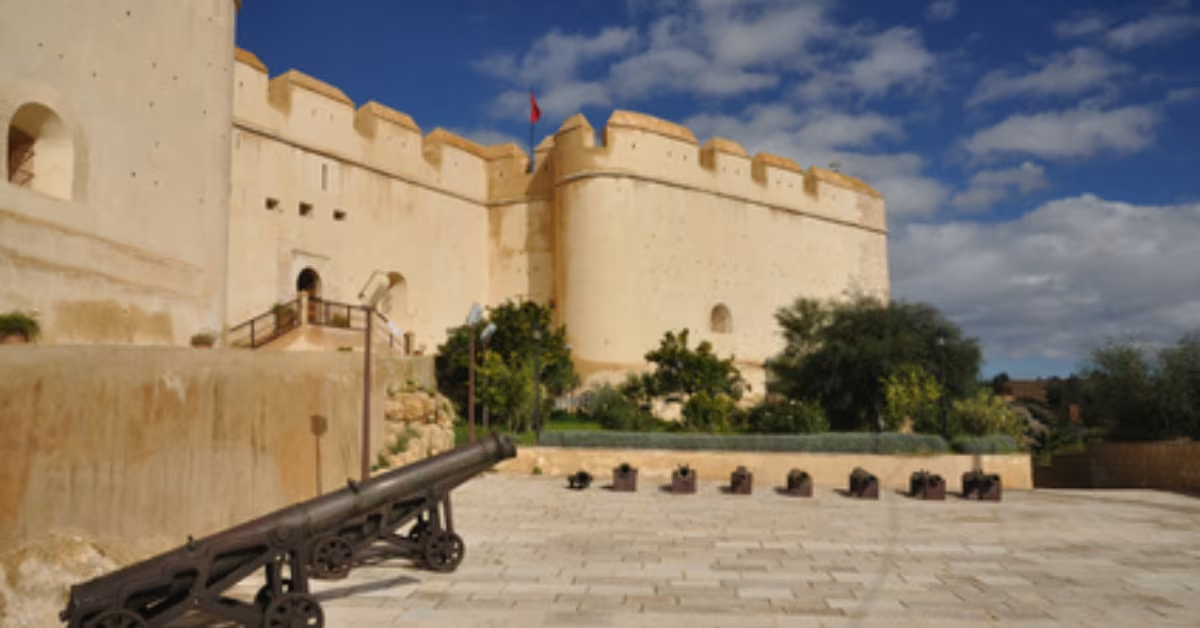
A Fort Built to Intimidate
The story starts in 1582. Sultan Ahmad al-Mansour of the Saadian dynasty ordered the construction of Borj Nord as part of a network of cannon-equipped forts positioned to overlook the old city, partly to keep a restless population in check, partly to ward off foreign invasion. In other words, it was built to make a point. It still does.
Look at it from a distance and you'd be forgiven for thinking you'd wandered into southern Portugal. The architecture draws heavily from 16th-century Portuguese fortress design: a square plan, four arrowhead-shaped bastions at the corners, and a terrace engineered to absorb the recoil of heavy artillery. This wasn't decorative. This was a statement.
Across the city, its twin, Borj Sud, stands guard on the opposite hill. Two fortresses, two sentinels, Fès pinned between them.
Over the centuries, the fort's purpose shifted. During the French Protectorate it served as a barracks, then a prison, not exactly a glorious reinvention. It wasn't until 1963 that Borj Nord became what it is today: Morocco's National Arms Museum.
What's Inside
The Arms Museum
Walking into Borj Nord feels like stepping through a fast-forward of human conflict. Spread across 15 rooms, the collection runs to over a thousand pieces, and the journey begins at the entrance itself, where two rifles and two sabres from southern Morocco set the tone.
The exhibits are arranged chronologically, taking you from prehistory all the way to the modern era: flint tools, axes, halberds, pikes, lances, sabres, swords, Iranian helmets, ornate saddles, flintlock muskets, pistols, revolvers, and cannons of every shape and era. It's a remarkably absorbing sweep through the history of warfare, and the bilingual information panels, in French and Arabic, make it easy to follow, even with kids in tow.
The undisputed star of the show? The "Sidi Mimoun" bronze cannon, cast in the 16th century, waiting for you just as you exit the museum. Enormous, magnificent, and an instant hit with children.
The View Over Fès el-Bali
Let's be honest: for many visitors, this is the real reason to make the trip up the hill. And it doesn't disappoint.
Late afternoon is the sweet spot. As the sun drops toward the horizon, a warm golden light washes over the rooftops of the old city, and the medina seems to glow from within. It's the kind of view that stops you mid-sentence.
Unlike the tourist-heavy terraces of Chefchaouen, charming but often staged, Borj Nord's vantage point feels raw and unfiltered. You're looking down at one of the best-preserved medieval cities on the planet, and there's nobody trying to sell you anything. Photography is prohibited inside the museum itself, but once you're out on the ramparts, the lens cap comes off. Make sure your memory card is empty.
Good to Know Before You Go
Opening hours: Open daily except Tuesdays. There's a midday closure, so plan around that if you're visiting in the middle of the day. During Ramadan, hours may change, so it's worth checking with your accommodation beforehand.
Entry fee: 10 dirhams for adults, 3 dirhams for under-15s. For the amount of content on offer, that's remarkable value.
Getting there: The easiest option is a petit taxi from the medina. The hill is a solid uphill walk, particularly brutal in summer heat. Budget around an hour to an hour and a half for the full visit, museum and panorama combined.
Best time to visit: Late afternoon, without question. The light on Fès el-Bali at golden hour is the sort of thing you'll still be thinking about on the plane home.
Do you need a guide? No. The museum is well-signposted, the panels are in French, and you can do the whole thing comfortably on your own. If someone offers "official guide" services at the entrance, know that it's entirely optional. Be polite, stay firm, and enjoy at your own pace.
Travelling with kids? This is an excellent family visit. Armour, swords, and a colossal bronze cannon: children are reliably captivated. Bring water and a snack, especially in the warmer months.
While You're Up Here: What to Visit Nearby
Once you've come back down the hill, Fès has plenty more to offer. Six spots worth making time for:
The Merenid Tombs: A ten-minute walk from Borj Nord, these 14th-century mausoleums are largely in ruins, which only adds to their atmosphere. The panoramic view over Fès el-Bali from here rivals anything in the city. Go at sunset if you can.
Medersa Bou Inania: One of the finest Quranic schools in Morocco, founded in the 14th century by the Merenids. The tilework, carved stucco and mashrabiya screens are extraordinary. It's also one of the few medersas in Fès open to non-Muslims, so don't take that for granted.
Chouara Tannery: You can't leave Fès without seeing the tanneries. The coloured dyeing vats, best viewed from the terraces of surrounding shops, are unlike anything else in the world. Accept the sprig of mint they'll hand you on arrival: the smell is, let's say, an experience in itself.
Bab Boujloud: The iconic blue-tiled gateway to the medina, built in 1913 and now the city's most recognisable landmark. Blue on the medina side, green on the city side. It's also the best starting point for diving into the labyrinthine streets of Fès el-Bali.
Musée Dar Batha: Set inside a 19th-century Andalusian palace, this museum holds a fine collection of regional arts and crafts: pottery, embroidery, carved wood, musical instruments. A beautiful introduction to Fassi craftsmanship, in a setting that deserves attention in its own right.
Jnan Sbil Garden: When you've had your fill of history, this public garden just outside Bab Boujloud is exactly what you need. Palm trees, pools, fountains, and a bench to sit on. Free entry, no agenda.
Borj Nord is the kind of place you stumble upon almost by accident and leave feeling quietly thrilled about. No crowds, no pressure, no inflated entry fee. Just a dense slice of history, a genuinely remarkable view, and the satisfying sense that you've found something most visitors walk straight past.Honest, unhurried, and frankly unforgettable. Don't skip it.
Register
By entering your email address, you agree to receive our newsletters by email and you are aware of our Privacy Policy.