Nejjarine Museum of Wooden Arts & Crafts in Fez
Fès surprises you. You think you're arriving in a medina like any other, and then you turn a corner, push open a door, and find yourself face to face with something you weren't expecting. The Nejjarine Museum is exactly that kind of place.
Housed in an 18th-century former fondouk right in the heart of Fès el-Bali, this museum dedicated to woodworking crafts is one of the finest in the city. Not the largest, not the most famous, but almost certainly the most memorable.
History and Architecture
A fondouk was originally a caravanserai: a stopover where merchants and their animals could rest for a few days, store their goods, and get back on the road. This one was built under the Alaouite dynasty and has carried itself through the centuries with remarkable grace.
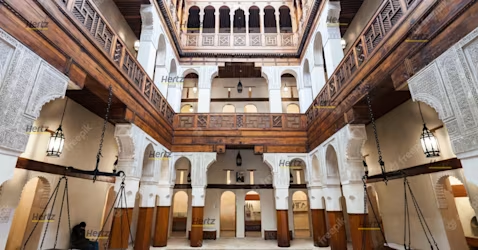
Today restored and transformed into a museum, the building has held onto every bit of its soul. The moment you cross the threshold, the inner courtyard stops you in your tracks. The zellige tilework underfoot, the carved wooden mashrabiyas, the cedar ceilings worked with almost absurd precision: everything here speaks to a craftsmanship you rarely see anymore. It is genuinely beautiful.
The Collections
Musical Instruments
This is usually the first thing that catches your eye. Ouds, citharas, flutes and traditional percussion instruments are displayed with care, some of them centuries old. The shapes are unusual, the materials surprising, and the explanatory cards give you a real sense of when and how these instruments were played. Children tend to stop and stare at them almost every time, which makes this a natural starting point for families.
Craftsmen's Tools
This is the quietest corner of the museum, and also one of the most fascinating. Old planes, wood chisels, mallets and compasses tell the story of the carpenters and cabinetmakers who shaped Fès for centuries. You quickly realise that the techniques used three hundred years ago are not all that different from what you can still watch in the workshops of the surrounding neighbourhood today.
Furniture and Everyday Objects
Low tables, carved chests, decorative panels, ornate doors: the furniture on display gives you a very concrete picture of what the interior of a well-to-do Fassi home looked like across different periods. Every piece is a small window onto a trade, an era, a way of living. This is not a static museum. It feels alive and accessible, and you leave with a much clearer understanding of Moroccan craftsmanship than an hour spent wandering through a souk would ever give you.
Place Nejjarine and the Rooftop Terrace
Nejjarine means carpenters in Arabic, and the neighbourhood lives up to the name: woodworking artisans still work in the streets around the museum, and the smell of cedar mingles with the sounds of the medina to create an atmosphere unlike anywhere else.
The square itself is anchored by a zellige and stucco fountain that is one of the most photographed spots in all of Fès. If you've been to Marrakech before coming here, the difference is striking: there, everything feels designed for tourists, whereas Place Nejjarine seems to exist on its own terms, for the people who live nearby. You slip in as a visitor without feeling like you're walking through a film set.
And then there is the terrace. That is the museum's real secret. From the top floor, the view across the rooftops of Fès el-Bali is breathtaking: a sea of green tiles, minarets and satellite dishes coexisting without any apparent conflict. In the morning, when the light is still soft, it is the best time to go up.
Practical Information and Nearby Sights
The museum is located on Place Nejjarine, in the Fès el-Bali medina. You reach it on foot from Place R'cif or from the Bou Inania Madrasa, following the lanes toward the carpenters' district. Allow around ten to fifteen minutes on foot from the main thoroughfares of the medina.
Opening hours are generally 10am to 5pm, though it is worth checking with your accommodation before you go, as times can vary by season. Entry is inexpensive, around 20 dirhams per person. The visit itself takes between 45 minutes and an hour and a half, depending on your pace and how long you spend on the rooftop.
In the same area, you can continue to the Zaouia of Moulay Idriss II, the city's most venerated shrine, and the surrounding souks overflowing with textiles, spices and leather goods. Half a day is enough to see everything without rushing, and it makes for one of the best possible introductions to Fès.
The Nejjarine Museum is unlike any other museum you will visit in Morocco. No vast air-conditioned galleries, no walls of text, no shuffling crowds. Just a magnificent building, an honest collection, and a rooftop terrace that is worth the trip on its own.
It is the kind of place you would recommend even to travellers who have no particular interest in history or craft, because the experience goes well beyond what is behind the glass cases. You come to see a museum and you leave with a sharper, truer image of Fès, somewhere between the cedar ceilings and the view from the roof.
If you take away one thing from this article: do not walk past it.
Register
By entering your email address, you agree to receive our newsletters by email and you are aware of our Privacy Policy.