Discover the Museum of Moroccan Judaism in Casablanca
Most tourists arriving in Casablanca have a pretty clear agenda: the Hassan II Mosque, the corniche, a coffee somewhere in the city centre. The Museum of Moroccan Judaism rarely makes the list. That's a mistake, and this article exists to make sure you don't make it.
This is the only museum of its kind in the Arab world. Entirely dedicated to the culture and history of Moroccan Jews, open to all, sitting quietly in a majority-Muslim city. For most visitors, it comes as a genuine surprise. The Morocco they thought they knew walking in is not quite the same one they walk out with.
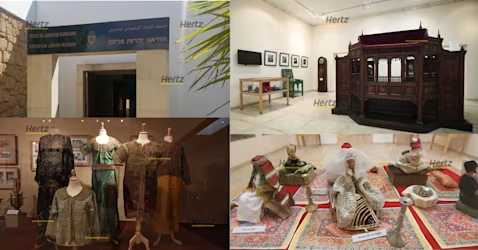
Jewish Life in Morocco: A History Nobody Told You About
A little context before you visit.
Jews have lived in Morocco for roughly 2,500 years. That's not a footnote, it's an entire civilisation that developed here, side by side with Muslim and Berber communities. Whole neighbourhoods called mellahs were dedicated to Jewish life in the kingdom's major cities. Fez, Marrakech, Meknes, Essaouira: each one has its own Jewish history, largely unknown, endlessly fascinating.
For centuries, this coexistence produced a rich and layered culture built on mutual borrowing, shared celebrations, and blended languages. Judeo-Moroccan, an Arabic dialect woven through with Hebrew, stands as one of the most striking examples of that exchange.
Then the 20th century arrived and changed everything. The founding of the State of Israel in 1948, independence movements, regional tensions: within a few decades, a Jewish community that had numbered over 250,000 people in the 1940s had almost entirely left the country. Today, a few thousand remain, mostly in Casablanca. A thousand-year-old presence reduced to a fragile thread, which the museum works hard to keep intact.
A Museum Built on the Refusal to Forget
The Museum of Moroccan Judaism opened in 1997, founded by the Israelite Community of Casablanca. The ambition was straightforward: collect, preserve, and pass on the cultural and religious heritage of Moroccan Jews before the last generations who lived it were gone.
It is as much a rescue mission as a cultural project. The result, housed in a quiet villa in the Oasis neighbourhood, looks unassuming from the outside. Inside, it's dense with emotion and meaning.
What You'll Find Inside
You don't expect much from the street. Then you step in.
The museum's rooms bring together several hundred carefully displayed objects. Liturgical items take centre stage: Torah scrolls wrapped in embroidered covers, finely crafted silver hanukkiot, ceremonial robes in vivid colours, hand-calligraphed parchments that have survived centuries. Every piece carries a story, often a family one, always intimate.
The reconstructed traditional synagogues are particularly well done. They give a clear and tangible sense of what religious life looked like in these communities, from the architecture to the everyday rituals.
The archival photographs may be what hits hardest. Family portraits, celebration scenes, images of mellahs that no longer exist: you find yourself looking at a Morocco that even many Moroccans have never seen.
Traditional costumes and Berber-Jewish jewellery round out the collection, reflecting an aesthetic sensibility shared across the country's different communities. Everyday objects, festive tableware, spice boxes, kitchen utensils, ground the exhibition in something warm and human, far from the cold glass-case atmosphere you might associate with a museum.
Families with children will find plenty to hold their attention too. The visual richness of the collections, the colourful costumes, the unfamiliar and glittering objects spark genuine curiosity in younger visitors. It can easily become the starting point for a real conversation about history, diversity, and how different communities have lived together.
Practical Information
Hours and admission: The museum is open Monday to Friday from 10am to 5pm, and Sunday morning. It is closed on Saturdays and Jewish holidays, so it's worth checking the dates before you go. Entry is around 30 dirhams per person, making it one of the most affordable visits in Casablanca, and easily one of the most memorable.
How long to allow: An hour to an hour and a half is enough to see everything at a relaxed pace. If you're visiting with curious children or with a guide who takes time over each piece, allow closer to two hours.
Getting there: The museum is located at 81 Rue Chasseur Jules Gros, in the Oasis neighbourhood, south of the city centre. A taxi is the easiest option, around ten minutes from the centre or from the Hassan II Mosque. Write down the exact address to show your driver, as the museum is a discreet address that not everyone knows.
Best time to visit: Weekday mornings are ideal. Fewer visitors, a calmer atmosphere, and guides who have more time for you. Weekends are manageable, but Sunday mornings can get a little busier.
Do you need a guide? Not strictly necessary, but it makes a real difference. The explanatory panels inside can be sparse, and without context, some pieces are hard to fully appreciate for visitors unfamiliar with Moroccan Jewish culture. The guides available on site tend to be knowledgeable and genuinely enthusiastic, just agree on a price before you start.
What to Do Nearby
Once you've finished at the museum, Casablanca still has plenty to offer. Here are six places worth adding to your day.
The Hassan II Mosque: Non-negotiable. Built over the Atlantic Ocean, with a 210-metre minaret and room for over 100,000 worshippers, it is one of the most spectacular buildings in Morocco. It is also one of the very few mosques in the world that welcomes non-Muslims inside, through guided tours organised every morning. The interior craftsmanship is extraordinary.
The Art Deco Quarter: Few visitors know this, but Casablanca is home to one of the finest concentrations of Art Deco architecture in the world, a legacy of the French Protectorate era. A one-hour walk through the city centre reveals ornate facades and architectural details that catch you completely off guard.
The Old Medina: Less dramatic than those of Fez or Marrakech, but genuine and easy to explore. The lanes are lively without being overrun by souvenir sellers, and the atmosphere is refreshingly low-pressure. A good place to wander with no particular plan.
The Corniche: Several kilometres of waterfront promenade along the Atlantic, lined with cafes and restaurants with terraces. The mood shifts with the hour, relaxed and family-friendly in the early evening, livelier after dark. It also offers the best views of the Hassan II Mosque at sunset.
Ligue Arabe Park: A large, shaded park right in the city centre, perfect for a breather after a day of sightseeing. Palm-lined paths, fountains, and plenty of benches in the shade make it a favourite with families travelling with young children.
Morocco Mall: A few minutes from the corniche, Morocco Mall is one of the largest shopping centres on the African continent. Beyond the shops, it works as an attraction in its own right: a giant aquarium, an ice rink, cinemas, and dozens of international restaurants under one roof. A solid end-of-day option, especially if you're travelling with kids.
Visiting the Museum of Moroccan Judaism means leaving with a picture of Morocco that is richer, more layered, and far more interesting than the postcard version. This is not a single culture. It is centuries of civilisations built on top of one another, and this museum is one of the most moving pieces of evidence you'll find.
Whether you're a history enthusiast, a curious traveller, or a parent looking to show your children that the world is more complex and more beautiful than it seems, this visit has something to offer you. Don't skip it.
Register
By entering your email address, you agree to receive our newsletters by email and you are aware of our Privacy Policy.