Explore the Dar Si Said Museum in Marrakech
Marrakech never lets you forget it's alive. The medina's alleyways buzz with vendors calling out, motorbikes honking, a thousand conversations happening at once. Then you turn down a quiet lane in the Riad Zitoun neighbourhood, push open an unremarkable door, and the city disappears. Welcome to Dar Si Saïd, one of the most quietly charming museums in the Red City, where Moroccan craftsmanship tells its own story, entirely on its own terms.
History & Context: Who Was Si Saïd?
The story begins in the second half of the 19th century. Dar Si Saïd was built as a grand palatial residence by Si Saïd Ben Moussa, who served as Minister of War under the regency of his brother Ba Hmad, the very same man who commissioned the magnificent Bahia Palace just a few minutes' walk away. Architectural ambition, it seems, ran in the family.
After Si Saïd's death in 1900, the palace changed hands and purpose several times. Around 1914, the French Protectorate turned it into the official residence of successive regional governors. By 1930, a new chapter began, and in 1932 the Administration des Beaux Arts formally converted the building into a museum. Today it carries a new official name, the National Museum of Weaving and Carpet, but the setting remains as exceptional as ever.
The Architecture: A Masterpiece Before You See a Single Exhibit
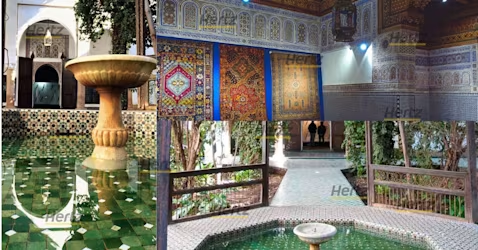
Before you look at anything on display, look at the walls. Seriously, take a moment. The entrance courtyard alone, traditional Moroccan in style with its central fountain, intricate zellige tilework, and delicately painted wooden doors, is the kind of place that has you reaching for your phone every thirty seconds.
The palace unfolds across several levels, organised around two interior courtyards. The sculpted and painted wooden ceilings, known as zouak, are simply remarkable. The finely carved arcades, stucco columns, and zellige floors speak to a craftsmanship that was passed down through generations, and that you will not find preserved to this standard anywhere else in such an intimate setting. If you have visited the museums of Fez, grander and more imposing in scale, Dar Si Saïd offers the opposite experience: human in proportion, hushed, almost secretive.
Kids, for what it's worth, tend to love wandering the courtyards. The space is open and airy, and there is always something to catch their eye at the right height.
The Collections: What Will You Actually See?
The undisputed highlight is the carpets. Upstairs, an extensive collection brings together rugs from across Morocco: Marrakech, Rabat, the Tensift valley, the High Atlas, the Souss, the Anti-Atlas, the Bani region, and the Tafilalet. Each piece is unique. Each pattern carries meaning, pointing to a tribe, a region, a moment in time.
Two major traditions are represented: the urban carpet, historically woven in Rabat, and the rural carpet, traditionally produced in the Atlas mountain range and the eastern regions of Morocco. The explanatory panels are clear and accessible, and video projections walk visitors through the history and evolution of Moroccan weaving. Useful if you want to understand what you're looking at without needing to hire a guide.
Beyond the carpets, the collections include woodwork, southern Moroccan jewellery, pottery and ceramics, weapons, traditional costumes, and a handful of archaeological pieces, among them an early 11th-century marble basin. In total, more than 4,000 objects of Moroccan art and craft are preserved here, studied, and largely on public display.
Practical Info and Tips for Your Visit
Getting there: The museum is located on Derb el Bahia, in the Riad Zitoun Jdid area of the medina, roughly halfway between Jemaa el-Fna to the north and the Bahia Palace to the south. On foot from the main square, allow around 15 minutes. By taxi, ask for "Riad Zitoun Jdid" and mention you're heading to the Dar Si Saïd museum.
Opening hours: Open every day except Tuesday. Morning sessions run from 9:00am to 12:15pm, afternoon sessions from 3:00pm to 6:15pm. Mind the midday break: if you show up at 12:10, you will not get in.
Admission: Adults pay 20 dirhams (roughly 2 euros). Children under 12 pay 5 dirhams (around 50 cents). For families, this is one of the most affordable cultural visits in all of Marrakech.
Important note: The museum sustained significant damage in the September 2023 earthquake and was closed for repairs. Before planning your visit, confirm its current status with your hotel or through the National Foundation of Moroccan Museums website.
How long to allow: Between 45 minutes and an hour and a half, depending on how much you want to linger. With children, plan for around an hour to explore at a comfortable pace.
Best time to visit: First thing in the morning, right at the 9:00am opening. The natural light falls beautifully through the interior courtyards, crowds are minimal, and the temperature is still pleasant before the midday heat kicks in.
Dress code: No strict rules here, unlike at mosques. That said, dress respectably and wear comfortable shoes: the zellige floors can be slippery in places.
Photography: Generally permitted in the common areas and courtyards. Check at the entrance regarding the exhibition rooms.
Do you need a guide? Not strictly necessary, but a good local guide can genuinely transform the visit. They will explain details about Berber carpet symbolism that no information panel ever could. Guides are available at the entrance, or can be arranged through your hotel or riad.
What to See Nearby
Dar Si Saïd sits in an ideal spot for building a rewarding cultural half-day in this corner of the medina. Five places worth visiting within easy walking distance:
The Bahia Palace is one of the finest palaces in Marrakech, built in the late 19th century for a grand vizier. Its fragrant gardens, zellige-decorated rooms, and carved cedar ceilings make it a favourite among visitors from around the world.
Museum Tiskiwin is a traditional townhouse sheltering a unique ethnographic collection tracing the caravan routes between Morocco and sub-Saharan Africa. Intimate and genuinely transporting.
The Bert-Flint Museum is dedicated to Moroccan folk arts and traditions, with a beautiful collection of Berber objects including jewellery, textiles, and pottery, all displayed in an authentic setting.
The El Badi Palace offers the majestic ruins of a 16th-century palace that was once considered among the most magnificent in the Islamic world. Its terraces give sweeping views over storks nesting on the medina rooftops.
The Riad Zitoun Souks, less visited than the grand souks to the north, are lined with local craft shops. After a morning in the museum, the carpets, ceramics, and woodwork you find there take on an entirely different resonance.
Dar Si Saïd is not the largest museum in Marrakech, nor the most famous. But it is often the one visitors remember most clearly. It brings together an exceptional palace, collections that genuinely illuminate Moroccan culture, and a calm that feels almost impossible to believe given how close you are to the chaos of Jemaa el-Fna. If you are after a moment of quiet and meaning away from the noise, this is where to find it. Just check the opening status before you go, and consider building it into a longer cultural loop through the neighbourhood.
Register
By entering your email address, you agree to receive our newsletters by email and you are aware of our Privacy Policy.