The Zaouia of Sidi Bel Abbes: Discovering Marrakech's Spiritual Heart
Marrakech is far more than its bustling souks, photogenic riads and the famous Jemaa el-Fna square. Beneath the tourist frenzy lies a profound spiritual dimension, embodied by the city's seven patron saints, known as the "Sebâatou Rijal". Among them, Sidi Bel Abbes holds a special place as the protector of Marrakech, the figure to whom locals have turned for centuries. His zaouia, tucked away in the northern reaches of the medina, remains a major pilgrimage site and offers a fascinating window into a Morocco that guidebooks seldom mention. Although the mausoleum itself is reserved for Muslims, the surrounding neighbourhood is well worth exploring and provides an authentic experience far removed from the usual tourist circuits.
Who Was Sidi Bel Abbes?
Sidi Bel Abbes, whose full name was Abou Al Abbas As-Sabti, lived during the twelfth century under the Almohad dynasty. Born in Ceuta, he eventually settled in Marrakech, where he dedicated his life to teaching, Sufi spirituality and, above all, caring for the most vulnerable members of society.
What distinguished him from the city's other saints was his tangible commitment to those in need. He is particularly renowned for taking the blind of Marrakech under his protection, providing them with shelter, food and dignity at a time when they were largely abandoned by society. This devotion to the marginalised earned him immense veneration, which endures to this day, some eight centuries later.
Upon his death around 1205, Sidi Bel Abbes was buried in Marrakech, and his tomb quickly became a place of pilgrimage. Over the centuries, successive sultans expanded and embellished the complex surrounding his mausoleum, transforming it into the city's most important zaouia. For the people of Marrakech, invoking Sidi Bel Abbes is akin to seeking a blessing from the city's guardian, the one who watches over souls and protects its walls.
The Zaouia: A Place of Devotion in the Heart of the Medina
Before proceeding further, a brief explanation is warranted for those unfamiliar with Moroccan religious traditions. A zaouia is a religious complex built around the tomb of a saint, typically comprising a mosque, prayer halls, fountains for ablutions, sometimes a Quranic school, and accommodation for pilgrims. It serves simultaneously as a place of worship, a spiritual centre and a refuge for those in need.
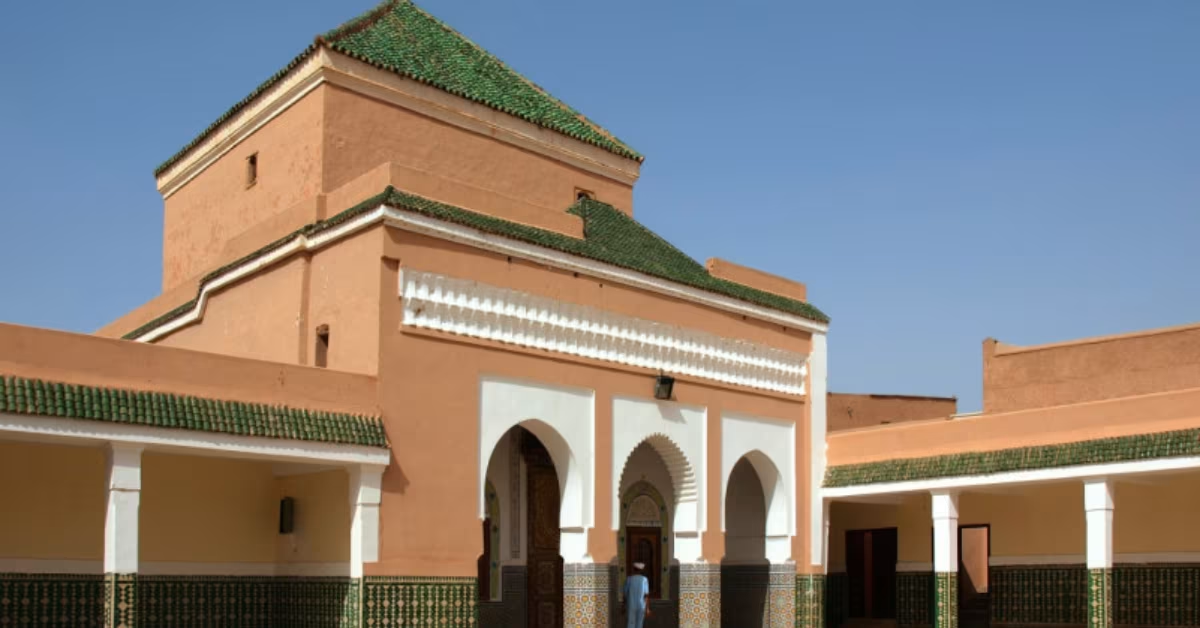
The Zaouia of Sidi Bel Abbes is the largest and most revered in Marrakech. The current complex dates primarily from the seventeenth century, when Sultan Moulay Ismail commissioned extensive renovation and expansion works. The architecture is understated yet elegant, featuring whitewashed walls, carved wooden doors, zellige fountains and shaded interior courtyards that invite quiet contemplation.
The atmosphere surrounding the zaouia is difficult to convey in words; it must be experienced firsthand. One is far removed from the commotion of the neighbouring souks, yet life here is very much in full swing. Worshippers come to pray, families bring offerings, and beggars await the charity of visitors, perpetuating the legacy of compassion left by the saint. There is something profoundly human about this place, a sincerity that stands in stark contrast to the occasionally contrived nature of the city's tourist attractions.
The neighbourhood surrounding the zaouia bears the saint's name and functions as a village within the city. The alleyways are quieter here, the residents more relaxed, and children play football between ochre-coloured walls. One encounters artisans at work, women chatting on their doorsteps, and cats dozing in the sun. This is the Marrakech that existed before mass tourism arrived.
Can the Zaouia Be Visited?
The interior of the mausoleum and mosque is strictly reserved for Muslims. This rule applies to virtually all places of worship in Morocco, with the notable exception of the Hassan II Mosque in Casablanca, and it should be respected without question.
That said, being unable to enter does not mean there is nothing to see. The area surrounding the zaouia is accessible to all and offers a compelling glimpse into the spiritual life of Marrakech. Visitors can admire the monumental doorways, observe the steady flow of worshippers entering and leaving, absorb the contemplative atmosphere of the neighbourhood and, with appropriate discretion, photograph the exteriors.
Respect is paramount here. Appropriate attire covering shoulders and knees is essential, boisterous behaviour should be avoided, and permission should always be sought before photographing individuals. The neighbourhood's residents are generally welcoming towards respectful visitors but have little patience for those who treat their home as a film set.
The value of visiting the zaouia, even without entering, lies precisely in this immersion. You will witness an authentic Marrakech, feel the popular devotion surrounding Sidi Bel Abbes, and gain a deeper understanding of the role spirituality plays in the daily lives of Moroccans. It is an experience quite different from visiting monuments, more subtle and intimate, and ultimately more rewarding.
Planning Your Visit: Practical Information and Recommendations
Location: The zaouia is situated in the Sidi Bel Abbes quarter, in the northern part of Marrakech's medina. As one of the city's seven historic neighbourhoods, it lies somewhat removed from the main tourist areas, which explains why it receives fewer foreign visitors.
Getting there: From Jemaa el-Fna square, allow approximately twenty to twenty-five minutes on foot, heading north through the souks before turning towards the Sidi Bel Abbes quarter. The route can be difficult to navigate within the medina's labyrinthine streets, so do not hesitate to ask locals for directions; they will be happy to assist. Alternatively, take a taxi to Bab Taghzout, one of the nearest gates to the medina, and continue on foot from there.
Opening hours: The zaouia is an active place of worship rather than a museum, and consequently there are no formal visiting hours. Avoid prayer times, particularly Friday early afternoon, out of respect for worshippers. Morning and late afternoon are generally the most suitable times for a leisurely stroll through the neighbourhood.
Admission: Access to the neighbourhood and the zaouia's surroundings is entirely free. Should you wish to do so, you may make a donation to the beggars near the entrance, in keeping with the tradition of charity established by Sidi Bel Abbes himself.
Duration: Allow approximately one hour to explore the neighbourhood at a relaxed pace, observe the zaouia's surroundings and absorb the atmosphere. If combining this with a wander through the adjacent alleyways and a tea break, two hours would be more appropriate.
Accessibility: The neighbourhood is located within the medina, which entails narrow alleyways, uneven cobblestones and an absence of pavements. Pushchairs are difficult to manoeuvre, and those with reduced mobility may struggle. However, the terrain is generally flat, without stairs or steep inclines, making it manageable for children who can walk independently.
Best time to visit: Morning is ideal, when the light is soft and the neighbourhood is quietly awakening. You will avoid the midday heat and enjoy a peaceful, almost contemplative atmosphere.
The annual moussem: This event is not to be missed if you happen to be in Marrakech at the right time. The pilgrimage, held each year, attracts thousands of worshippers who come to honour the memory of Sidi Bel Abbes. Processions, chanting and collective prayers create an extraordinary immersion in spiritual Morocco, both intense and deeply moving. Dates vary according to the calendar, so do enquire before your trip.
Six Nearby Attractions Worth Visiting
The Zaouia of Sidi Bel Abbes is located within Marrakech's medina, which means you are never far from the city's other attractions. Here are six must-see sites to combine with your visit to the neighbourhood.
Jardin Majorelle: arguably the most famous garden in Morocco, renowned for its iconic intense blue and its collection of cacti and exotic plants. Created by Jacques Majorelle and later restored by Yves Saint Laurent, it offers a refreshing retreat just a short taxi ride from the medina.
Medersa Ben Youssef: the former Quranic school of Marrakech and one of the finest examples of Islamic architecture in the country. With its zellige-adorned courtyards and carved cedar ceilings, it lies within easy walking distance of the zaouia.
Bahia Palace: a masterpiece of nineteenth-century Moroccan art de vivre, featuring sumptuous salons, fragrant gardens and interior courtyards of extraordinary elegance. Children particularly enjoy exploring its maze of rooms.
Saadian Tombs: concealed for centuries before their rediscovery in 1917, these tombs display marble, stucco and ceramics of exceptional refinement. The site is compact but utterly magnificent.
Marrakech Museum: housed in a former palace, it presents collections of Moroccan art within an interior architecture that merits a visit in its own right. The central patio, with its immense suspended chandelier, is particularly photogenic.
Jemaa el-Fna Square: requiring no introduction whatsoever. Storytellers, musicians, snake charmers and orange juice vendors converge here to create the beating heart of Marrakech, especially at nightfall when the food stalls are set up.
Why the Zaouia of Sidi Bel Abbes Is Worth the Visit
Marrakech attracts millions of visitors each year, yet how many take the time to venture beyond the well-trodden paths? The Zaouia of Sidi Bel Abbes offers a rare respite from the city's tourist whirlwind, a moment of calm and authenticity amidst the bustle.
You will most likely not enter the mausoleum, and that is perfectly acceptable. What matters is the experience itself: walking through a neighbourhood where time appears suspended, observing the quiet devotion of worshippers, and understanding that Marrakech is not merely a postcard but a living city with its beliefs, traditions and patron saints.
This is a visit that may not appeal to those seeking spectacular monuments or Instagram opportunities. However, for curious travellers who wish to look beneath the surface and discover a city's soul, the Zaouia of Sidi Bel Abbes represents a valuable stop, the kind that lends meaning to a journey and leaves lasting memories.
Register
By entering your email address, you agree to receive our newsletters by email and you are aware of our Privacy Policy.