Discover Tamga Natural Reserve
Morocco extends far beyond its medinas, souks and crowded beaches. Away from the conventional tourist circuits, the country conceals natural treasures of striking beauty, and the Tamga Nature Reserve is among them. Nestled in the heart of the Central High Atlas, within the celebrated Aït Bouguemez Valley, this protected area offers breathtaking landscapes, remarkable biodiversity and total immersion in an authentic Morocco, one of perched Berber villages, mountain trails and silence. If you dream of wild nature, genuine human encounters and gentle adventure, Tamga Reserve deserves a prominent place on your itinerary.
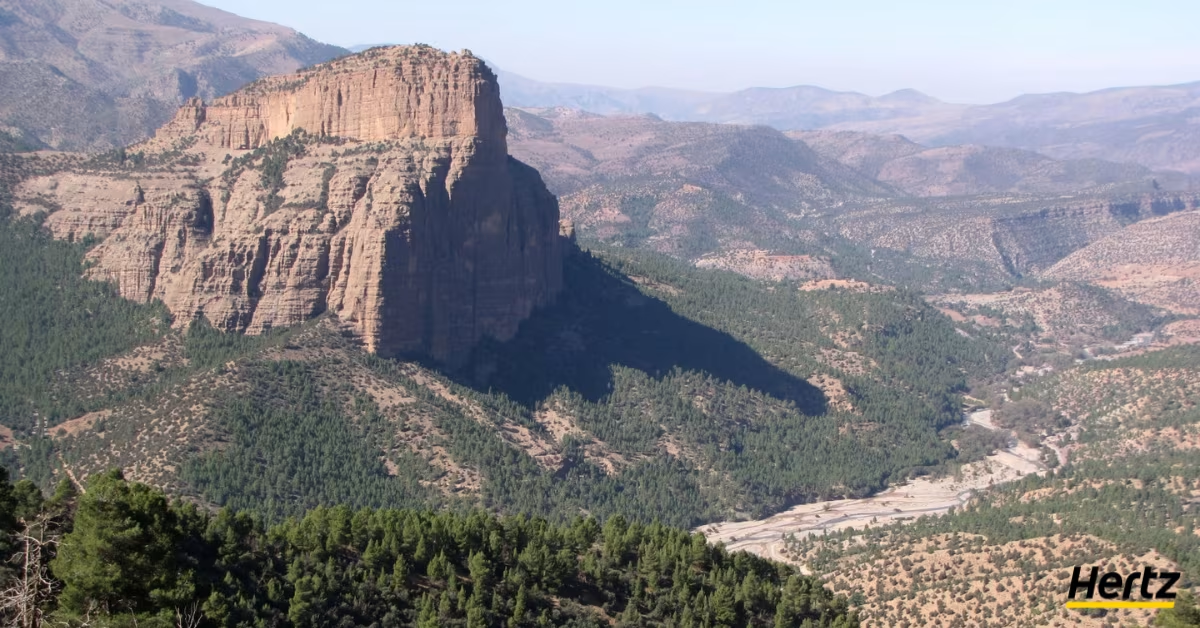
Tamga Nature Reserve: An Overview
The Tamga Nature Reserve is situated in the province of Azilal, at the heart of the Central High Atlas, approximately 200 kilometres from Marrakech. This is a mountainous, remote region where time appears to have stood still and where nature has maintained its dominion against the advance of the modern world.
This area was granted protected status to preserve a fragile ecosystem threatened by overgrazing, deforestation and climate change. The High Atlas mountains harbour unique biodiversity, with animal and plant species found nowhere else in Morocco, and sometimes nowhere else on Earth. Protecting Tamga means safeguarding an irreplaceable natural heritage.
The reserve's landscapes are remarkably varied. Within just a few kilometres, one passes from verdant valley floors, where rivers flow between poplar-lined banks, to juniper forests clinging to the slopes, then to windswept rocky ridges. Traditional pisé villages, built into the mountainsides, punctuate the scenery and serve as a reminder that humans have lived here for centuries, in harmony with their environment.
The reserve remains largely unknown to tourists, which constitutes both its charm and its vulnerability. You will encounter no crowds here, no tour coaches, no souvenir vendors. Just the mountain, the silence, and a handful of hikers who have come seeking authenticity.
The Reserve's Flora and Fauna
The Tamga Nature Reserve is home to remarkable wildlife, though it tends to be elusive and requires patience and careful observation to spot.
The emblematic species of the area is the Barbary sheep, a wild ovine with impressive curved horns that inhabits the rocky, precipitous zones. With a measure of luck and discretion, you may observe them at sunrise or sunset, when they descend towards water sources. Barbary macaques, also found in other regions of the Middle Atlas, inhabit the reserve's forests, along with wild boar, foxes, jackals and a multitude of smaller mammals.
The skies above Tamga are the realm of raptors. Golden eagles, griffon vultures, common buzzards and falcons soar above the ridges, riding the thermals to hunt or simply survey their territory. For ornithology enthusiasts, it is a perpetual spectacle that never fails to captivate.
Regarding vegetation, the reserve presents a mosaic of ecosystems that vary according to altitude and aspect. In the valleys, one finds terraced crops, orchards and walnut groves. Higher up, forests of thuriferous juniper, those gnarled, millennia-old trees, blanket the slopes and provide crucial habitat for wildlife. Higher still, vegetation becomes sparse, giving way to alpine meadows dotted with endemic flowers in spring.
This biodiversity is precious, yet it is also fragile. Climate change, human pressure and overgrazing threaten the equilibrium of these ecosystems, which is precisely why the reserve was established. As a visitor, you have a role to play: keep to the marked trails, do not disturb the animals, pick nothing, and take your rubbish with you. It is simple, but it is essential.
What to Do in the Reserve and Its Surroundings
The Tamga Nature Reserve and the surrounding Aït Bouguemez Valley offer a wealth of activities for nature and culture enthusiasts, whether you are an experienced hiker or simply a walker in search of a change of scenery.
Hiking is naturally the principal activity. Trails of all difficulty levels crisscross the reserve, allowing visitors to discover its varied landscapes, from valley floors to summit ridges. Some routes are suitable for families with children, whilst others demand solid physical fitness and several days of walking. In all cases, the panoramas are stunning and more than justify the effort.
Wildlife observation requires somewhat more patience, but the rewards are commensurate. Early morning and late afternoon are the optimal times for spotting Barbary sheep, raptors or macaques. Bring binoculars, remain silent, and let nature come to you. It is a contemplative experience, far removed from the bustle of daily life.
Discovering the Berber villages forms an integral part of the experience. The valley's inhabitants still largely follow ancestral traditions, cultivating their terraced lands, raising their livestock and crafting their goods by hand. The welcome is warm, often accompanied by mint tea, and exchanges, even when limited by the language barrier, are invariably rich in humanity.
The collective granaries, known as "igoudar" in Berber, represent a unique heritage of the region. These fortified structures, perched atop rocky outcrops, were formerly used to store harvests and the villagers' precious possessions. Some remain in use today, whilst others lie in ruins yet remain impressive. They constitute a fascinating testament to the social organisation of Berber communities.
Encountering local residents can extend further if you wish. Several families offer homestay accommodation, an arrangement that allows visitors to share the daily life of locals, sample their cuisine and discover their way of life from within. For children, it is an incomparable educational experience, far more enriching than a night in a standardised hotel.
Planning Your Visit: Practical Information and Advice
How to get there? From Marrakech, allow approximately four to five hours by road via Azilal. The journey is part of the experience, with magnificent landscapes at every turn. A car is essential, preferably a 4x4 for secondary tracks, although the main road is now surfaced.
Best time to visit? Spring (April to June) is ideal, with mild temperatures and lush vegetation. Autumn (September to November) offers magnificent colours and exceptional light. Summer remains pleasant at altitude, whilst winter is harsh but magical for devotees of winter trekking.
Is a guide necessary? It is not compulsory for straightforward hikes, but is strongly recommended for exploring the reserve in depth or undertaking multi-day treks. Local guides know the trails, the best observation spots, and their engagement guarantees direct economic benefit to the communities.
What to bring? Good hiking boots, warm clothing for cold nights at altitude, sufficient water, sun protection and binoculars for wildlife observation.
Visiting with children? Entirely feasible if you adapt hikes to their age. Walks around the villages and visits to the collective granaries are particularly popular with younger visitors. Allow for a relaxed pace and plenty of snacks.
Accommodation? Options are simple but authentic: guesthouses run by local families, bivouacking in designated areas, or homestays for complete immersion.
Six Activities to Enjoy in the Region
The Tamga Nature Reserve lies within an exceptional region, the Central High Atlas, which abounds with natural and cultural treasures. Here are six unmissable activities to combine with your visit.
Hiking in the Aït Bouguemez Valley: nicknamed the "Happy Valley", this is one of the most beautiful valleys in Morocco, with its pisé villages, terraced fields and snow-capped peaks as a backdrop. Several days of walking are insufficient to exhaust its wonders.
Climbing M'Goun: at 4,071 metres, M'Goun is Morocco's second highest peak after Toubkal. The ascent is demanding but accessible to hikers in good physical condition, and the view from the summit is unforgettable. Unlike Toubkal, which is often crowded and has become something of a mountain motorway during high season, M'Goun offers a wilder, more solitary experience.
Visiting Ouzoud Falls: a few hours' drive from the valley, these spectacular waterfalls, over 100 metres high, rank among the most beautiful in the country. One can swim in the natural pools, observe the Barbary macaques living on the cliffs, and enjoy the numerous cafés with views of the cascades.
Discovering Bin El Ouidane Lake: this large reservoir, with its turquoise waters surrounded by arid mountains, presents a surprising landscape and opportunities for swimming, fishing or simply contemplation. It makes a pleasant stop on the road between Marrakech and the valley.
Exploring the Ahansal Gorges: these deep, spectacular gorges, carved by the Ahansal River, offer an ideal playground for canyoning enthusiasts, hikers or simply those who appreciate grand scenery. Access requires an all-terrain vehicle, but the adventure is well worth it.
Trekking to the Izourar Lakes plateau: perched at over 2,500 metres altitude, these mountain lakes offer a peaceful, unspoilt setting, ideal for a bivouac beneath the stars. The trek to reach them traverses varied landscapes and affords opportunities to observe flora and fauna typical of the High Atlas.
Why Tamga Nature Reserve Is Worth the Journey
The Tamga Nature Reserve is not a destination for everyone. It requires some effort to reach, a certain appetite for adventure and a genuine desire to venture off the beaten track. But for those who make the journey, the reward is immense.
You will discover a wild and preserved Morocco, landscapes of raw beauty, unique flora and fauna, and human communities still living in harmony with their environment. You will return with memories quite unlike anything offered by conventional tourist circuits.
Above all, by visiting the reserve responsibly, respecting nature and supporting the local economy, you will contribute to preserving this treasure for future generations. Perhaps that is the true luxury of travel today: discovering intact places and ensuring they remain so.
Register
By entering your email address, you agree to receive our newsletters by email and you are aware of our Privacy Policy.