Place des Ferblantiers Marrakech
Place des Ferblantiers, Marrakech: The Craft Square Most Visitors Walk Past
Everyone knows Marrakech. The Jemaa el-Fna square, the packed souks, the photogenic riads, the horse-drawn carriages and the spice sellers calling out from their stalls. That is the spectacular Marrakech, the one you come looking for and find without any effort at all.
But there is another Marrakech, quieter, more artisanal, less staged. The Place des Ferblantiers belongs to that one.
Tucked at the gates of the mellah, a short walk from the buzz of Jemaa el-Fna, this square is the domain of the metalworkers, the craftsmen who hand-make the copper and wrought iron lanterns you see hanging in riads across the entire country. It is intermittently noisy, it smells of hot metal, and it is genuinely fascinating to watch. Here is everything you need to know before you go.
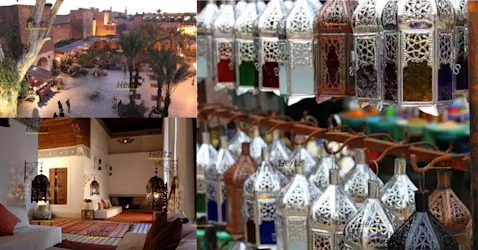
Where Is the Place des Ferblantiers?
The Place des Ferblantiers sits in the southern part of the Marrakech medina, at the junction between the mellah, the city's old Jewish quarter, and the El Badi Palace district. It is a pivotal location, where history, craftsmanship and heritage converge, making it a natural stop on any tour of the old city.
From Jemaa el-Fna, allow around fifteen to twenty minutes on foot heading south through the souks. The walk itself is worth it. From your riad or hotel, a petit taxi gets you there in a few minutes for next to nothing. A calèche is a pleasant option if you are travelling with children, and the drivers know the address without needing directions.
History and Identity: The Metalworkers' Quarter
The square takes its name from a specific and ancient trade: the ferblantier, the craftsman who specialises in working tin, copper and lightweight metals by hand to produce everyday objects and decorative pieces with a level of precision and patience that is genuinely impressive to witness.
The quarter is historically tied to the neighbouring mellah, Marrakech's Jewish quarter founded in the 16th century. Jewish and Muslim craftsmen worked side by side here for generations, building a mixed artisanal identity that outlasted the departure of the Jewish community to Israel and France in the 1950s and 60s. Visible traces of that cohabitation are few today, but the atmosphere of the quarter still carries something of that shared history.
What sets the Place des Ferblantiers apart from other craft spaces in Marrakech is that it has not been museumified. This is not a tourist cooperative where artisans perform their trade for visitors. It is a genuine open-air workshop, where men are working, metal shavings litter the ground, and the rhythm of mallets on copper marks the hours. The authenticity is unmistakable.
What to See and Do
The Workshops
The first thing to do is slow down and watch. The craftsmen work in full view, cutting, hammering, welding and chiselling metal with precise, repeated gestures passed down across generations. It is hypnotic. Children are often captivated, and the artisans, well used to curious onlookers, welcome the attention with good humour.
The Lanterns
The square's signature product is the lantern. Dozens of different styles, from the simplest to the most elaborate, in raw copper, painted metal or wrought iron with coloured glass inserts that project geometric patterns across walls when lit. They are beautiful, unmistakably Moroccan, and the ideal thing to bring home, provided you negotiate the price properly.
El Badi Palace
A two-minute walk from the square, El Badi Palace is a major historical site that tends to get overlooked by visitors in a hurry to reach the souks. Built in the 16th century by Sultan Ahmed el-Mansour, it was once one of the most lavish palaces in the world, with Italian marble and vast reflecting pools. What remains today is ruins, but ruins of a striking and enduring grandeur, and the view from the ramparts across the city towards the Atlas mountains is absolutely worth it.
The Mellah
The Marrakech mellah is one of the city's most compelling and least-visited neighbourhoods. Its narrow alleys, ornately carved wooden balconies, former synagogue and well-kept Jewish cemetery tell a lesser-known chapter of Moroccan history, one of multi-generational cohabitation between communities. Half an hour wandering its streets is time well spent.
The Spice Market
A few minutes' walk from the square, the spice market is an olfactory experience unlike almost anything else. Cumin, saffron, ras el hanout, orange blossom: the colours and aromas collide in what feels like beautifully organised chaos. A full sensory experience, particularly enjoyable with children.
Buying a Lantern: How to Negotiate
Negotiating is a non-negotiable ritual on the Place des Ferblantiers. The asking price is never the final price, and the sellers know it as well as you do. Start at roughly half the stated price, move gradually, and do not hesitate to walk away if the number does not work for you. Everyone knows how the game is played, and it is conducted with smiles on both sides.
Around the Square: What Else to See Nearby
The neighbourhood surrounding the Place des Ferblantiers is one of the richest in Marrakech for sightseeing. You could easily fill an entire day here without running out of things to do.
Jemaa el-Fna is about twenty minutes on foot. Snake charmers, storytellers, Gnawa musicians, orange juice vendors and open-air restaurants: the energy never stops, but it peaks in the evening when the square transforms into an open-air spectacle found nowhere else on earth.
The Bahia Palace, five minutes' walk away, is one of the finest examples of 19th-century Moroccan palatial architecture. Its zellige-tiled rooms, painted wooden ceilings and interior gardens planted with orange trees make it a site not to miss, and the large shaded courtyards are particularly popular with children.
The Saadian Tombs, rediscovered by chance in 1917 behind a wall of El Badi Palace, house the burial chambers of the 16th-century Saadian dynasty in an extraordinary setting of marble and stucco work. The site is small but of remarkable beauty, and the visit takes no more than thirty minutes. Do not skip it.
The Marrakech Museum, housed in the magnificent Mnebhi Palace, presents collections of ancient and contemporary Moroccan art in a setting whose architecture alone justifies the entrance fee. The central courtyard, with its enormous copper basin and hanging chandeliers, is one of the most beautiful interior spaces in the entire medina.
The Menara Gardens, roughly twenty minutes by taxi from the square, offer a welcome breath of fresh air after the intensity of the medina. A large pool surrounded by ancient olive trees, a historic pavilion in the background, and the snow-capped Atlas mountains visible on clear days. A perfect place to unwind with the family.
The Medina Souks are a labyrinth organised by trade, tanners, weavers, leather workers, potters, slipper makers, and you can lose yourself in them for hours with a guilty kind of pleasure. The souks are vivid, colourful, occasionally overwhelming, and always fascinating. Set aside at least a half-day and wear comfortable shoes.
The Place des Ferblantiers is not an attraction in the conventional sense. There is no entrance ticket, no audio guide. You stop, you watch men practise a craft they have inherited across generations, you perhaps buy a lantern to take home, and you leave with the feeling of having seen something real.
In a city as heavily touristed as Marrakech, that is a rare thing. And it is precisely why the square deserves a place in your itinerary.
Register
By entering your email address, you agree to receive our newsletters by email and you are aware of our Privacy Policy.