
Discover Place de France in Tangier
Place de France, Tangier: Where Two Worlds Have Always Met
Tangier is a city like no other. Never entirely Moroccan, never entirely European, it has always occupied this suspended point between two worlds, a city where cultures have been crossing paths for centuries without ever quite merging. And the Place de France is the whole thing distilled into a single square.
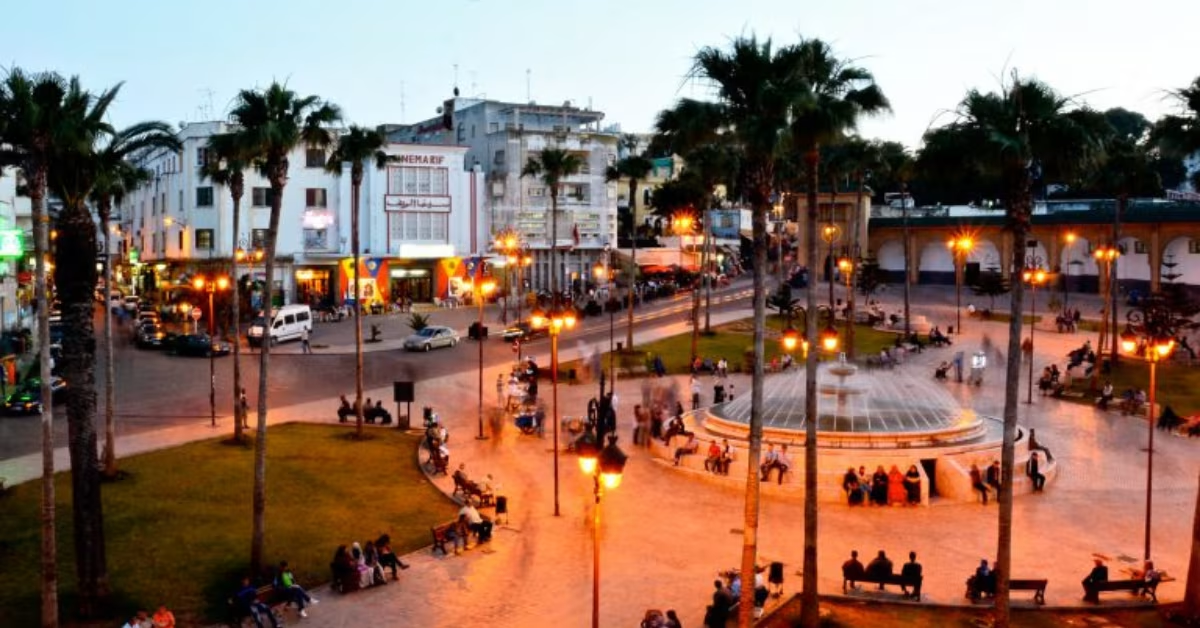
A café terrace, men reading the newspaper, tourists working out which direction to head, Tangierois meeting up at the end of the day as their parents and grandparents did before them. It is alive, it is mixed, it is Tangier.
In this article, we take you through this iconic square: its history, what to do there, and why it makes the perfect starting point for exploring the city.
History and Identity: A Square With a Long Memory
To understand the Place de France, you first need to understand Tangier. Between 1923 and 1956, the city held the status of an international zone, jointly administered by several European powers alongside Morocco. A unique historical parenthesis that made it an extraordinary territory: cosmopolitan, edgy and intensely alive, where diplomats, merchants, exiled artists, spies and adventurers of every stripe rubbed shoulders on a daily basis.
It was in this context that the Place de France took shape and established itself as the nerve centre of Tangerine life. Europeans settled around it, cafés multiplied, and the square naturally became the place where everyone gathered, regardless of nationality or social standing.
Among its most famous regulars were names that still carry a certain glamour. Paul Bowles, the American writer who spent much of his life in Tangier and helped forge the city's legend. Henri Matisse, who visited and found a quality of light and colour he could not replicate anywhere else. William Burroughs, Tennessee Williams, and a handful of other Beat Generation figures who saw in Tangier a freedom that was simply unavailable back in America. And of course the diplomats and spies, who were said to favour the square's café terraces for watching, listening and conducting quiet business.
The Grand Café de France is inseparable from all of this. Opened during the international era, it quickly became the city's living room, the meeting point for intellectuals, journalists and passing travellers. Its walls have absorbed a century of Tangerine history, and the place still carries a languid, retro atmosphere that sits in pleasant contrast to the modern city buzzing around it.
Since Moroccan independence in 1956, the square has evolved, but it has not lost its character. It is officially known in some contexts as the Place du Grand Socco, but Tangierois have always called it the Place de France, as if the name still carried something essential about who the city is. It remains a place of daily life, encounter and passage, exactly as it has always been.
What to See and Do Around the Place de France
The Grand Café de France
The first thing to do when you arrive at the square is sit down at the Grand Café de France, order a mint tea or a coffee, and take your time looking around. The interior has barely changed: wooden fittings, tall windows, and that slightly time-suspended atmosphere that gives the place all its charm. It is not the most modern café in Tangier. That is entirely the point.
Boulevard Pasteur
The Place de France is the natural starting point for Boulevard Pasteur, the main promenade of modern Tangier. Shops, banks, café terraces, bookshops: this is where the new city's pulse is strongest, with the energy building through late afternoon as locals come out for their evening walk. An easy and enjoyable stroll, accessible to everyone including young children.
The View Across the Strait of Gibraltar
From certain terraces near the square, on a clear day, you can make out the Spanish coastline on the other side of the Strait of Gibraltar. Just 14 kilometres separate Africa from Europe at this point, and that geographical proximity gives Tangier a dimension you do not feel in any other Moroccan city. The view is simple. It stays with you.
Sitting Still and Watching
The best thing to do on the Place de France is not listed in any guidebook. It is to sit down, order something, and let the city come to you. Children watch the pigeons, adults watch the steady flow of passers-by, and everyone eventually understands why this square has been drawing travellers for a century. Tangier is not really a city you visit. It is one you absorb.
Practical Information
Getting There : The Place de France is central and easy to reach. From the port, allow around twenty minutes on foot heading up towards the upper town, or five minutes by petit taxi. From the station, a taxi drops you there directly for a few dirhams. From Ibn Battouta Airport, count on roughly 30 minutes by taxi at a reasonable fare by Moroccan standards.
Best Time to Visit : Tangier is pleasant year-round thanks to its coastal position. Spring and autumn offer the best conditions: mild temperatures and exceptional light. Summer can be warm and busy; winter is mild but occasionally windy.
Accommodation and Food : The neighbourhood around the square has a solid selection of hotels and character riads across all budgets. Along Boulevard Pasteur and the adjacent side streets, you will find good local restaurants where you can eat well without spending much.
Practical Tips : As in all Moroccan tourist cities, be wary of unofficial guides who approach you on arrival. Always agree on a taxi fare before you get in. Dress around the square is relaxed, as it is an open and cosmopolitan area, but cover up more if you are heading into the medina.
A Square That Starts Everything
The Place de France is not a monument. You do not enter it, you do not visit it in the conventional sense. You settle into it, let it carry you along, and begin to understand what makes Tangier so singular.
It is a square that has seen history, artists, spies and ordinary travellers pass through, and it continues to receive them all with the same elegant indifference. A fine place to begin exploring the city, and more often than not, the place you find yourself wanting to return to at the end of the day.